
Unlocking the RF battlefield: Enabling modularity, speed, and interoperability
StoryFebruary 06, 2026

Matt Sipe
To The King LLC
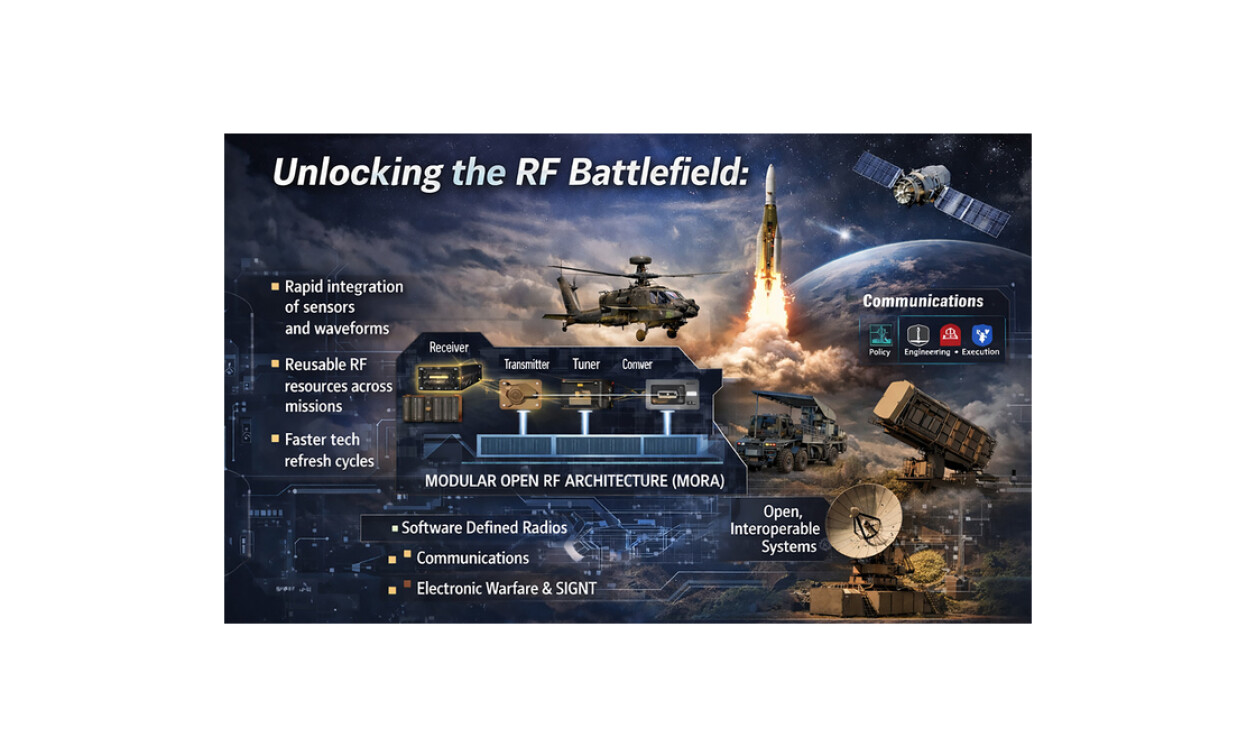
The radio-frequency (RF) battlespace will continue to grow more complex. Even so, with the right architectural foundations – backed by empowered governance, industrial engagement, and cross-service alignment – the U.S. Department of Defense (DoD) can build modular, adaptive, and resilient spectrum systems capable of dominating this domain for decades to come. The Modular Open RF Architecture (MORA) stands as a foundational element of the larger modular open systems approach (MOSA) transformation underway across the services.
The electromagnetic spectrum has rapidly transformed from a supporting function of warfare into a primary battlespace – one that is congested, contested, and evolving at a pace that traditional acquisition systems struggle to match. Modern military operations depend on agility in communications, sensing, electronic attack, and spectrum maneuver. Yet for decades, the U.S. Department of Defense (DoD) and its partners have been burdened by RF systems that are vertically integrated, difficult to upgrade, and expensive to sustain.
Recognizing this challenge early, the U.S. Army’s C5ISR [Command, Control, Communications, Computers, Cyber, Intelligence, Surveillance and Reconnaissance] Center began systematically addressing the underlying architectural issues that plagued RF modernization efforts and contributed to runaway SWaP-C [size, weight, power, and cost] problems across platforms. Their answer was the Modular Open RF Architecture (MORA) – a bold attempt to fundamentally rearchitect how RF subsystems are designed, integrated, and maintained. Now at Version 2.5, with the community closely watching for the anticipated 3.0 release, MORA stands as a foundational element of the larger modular open systems approach (MOSA) transformation underway across the services.
Why MORA matters more than ever
At its core, MORA is about modularity and abstraction – breaking monolithic RF systems into discoverable, reusable, and interoperable components. It defines a clean, open architecture for RF building blocks such as receivers, transmitters, tuners, converters, and digital processors. Through well-defined interfaces and the MORA Data Message (MDM) protocol, the architecture separates hardware from software, control from processing, and mission applications from the physical RF chain.
This structural decoupling is powerful, shifting RF modernization from hardware-first, vendor-locked stovepipes to software-driven, platform-agnostic modularity, enabling:
- Rapid integration of new sensors, payloads, and waveforms
- Reuse of RF resources across communications, signals intelligence (SIGINT), and electronic warfare (EW) missions
- Healthy competition among vendors at the module level, not the system level
- Technology refresh cycles measured in months, not decades
In other words: MORA enables the DoD to bring speed and competition back into RF modernization – areas historically dominated by inflexible designs and proprietary implementations.
MORA in communications and EW: a true cross-domain enabler
Modern communications systems rely on increasingly dynamic environments – multiband, multi-access solutions spanning tactical voice, satellite communications, resilient mesh networks, 5G, and beyond. MORA enables these capabilities by abstracting RF front-end components so that software-defined radios (SDRs) can evolve through software updates rather than repeated hardware procurements. An SDR built around MORA can migrate waveforms, upgrade tuning ranges, or expand mission sets without replacing the entire radio stack.
In EW and spectrum operations, the benefits are equally transformative. MORA’s open interfaces enable rapid insertion of digital receivers, advanced jamming modules, adaptive beamforming cards, and artificial intelligence (AI)-accelerated processors. Since the architecture includes support for high-speed, low-latency pathways (e.g., MORA low-latency bus, VITA 49.2, IEEE 802.1Q), its devices can participate in time-critical RF loops that legacy systems simply cannot achieve without proprietary integration.
EW has long suffered from vendor-unique RF chains that inhibit rapid innovation. MORA flips that model: It enables a shared framework where government, primes, nontraditionals, and allies all build against the same architectural substrate, accelerating development while protecting the government’s long-term flexibility.
The interoperability challenge: variation without governance
Across the DoD, nearly every service and major program has attempted to create or adopt its own RF or open architecture. These attempts were often undertaken in good faith, responding to their mission-specific needs. But the cumulative effect has been counterproductive: Instead of converging on shared, synergistic interfaces, these attempts have created a patchwork of unmanaged variation points, resulting in unique implementations of standards, dialects of architectures, and incompatible interpretations of open interfaces.
This proliferation of “butterfly variants” is not the fault of engineers. It is a symptom of a bureaucracy that lacks a unified architectural strategy and does not incentivize cross-program synergy. Program offices are understaffed, overloaded, and frequently rewarded for delivering their program’s solution instead of for making solutions reusable across other services or mission families.
This situation creates a downward spiral:
1. Programs innovate in isolation.
2. Variants emerge with no feedback loop to the originating standard.
3. Other programs cannot reuse the work because the “open” standard is now fragmented.
4. The community fails to converge, and stovepipes reemerge under a new name.
This is not an argument for one MOSA standard for all of DoD. Instead, it is a call for intelligent governance of variation – where architecture owners receive feedback, integrate lessons learned, enforce compliance where appropriate, and reduce divergence where harmful.
Without this level of coordination, MORA and other open standards risk becoming yet another set of siloed, incompatible solutions.
Where synergies should – and must – be found
Multiple architectures and standards intersect across the C5ISR, aviation, EW, and comms domains. Many already address overlapping problem sets and could be harmonized:
- VITA and OpenVPX (hardware profiles and backplane connectivity)
- MORA (RF modularity and signal transport abstraction)
- CMOSS (Army implementation of modular open systems)
- SOSA Technical Standard (tri-service sensor architecture and slot profiles)
- VICTORY (platform data bus and network abstraction)
- OMS/UCI and AMS-GRA (Air Force mission systems interoperability)
- Big Iron (high-performance EW systems)
- COARPs (radar processing systems)
- Aviation Mission Computing Environment and comms/datalinks/controls
- HOST (interoperable computing hardware)
The real opportunity is not to pick winners, but to define how these standards interoperate along the RF-processing-compute chain. MORA plays a critical role here – bridging RF hardware with digital signal-processing pipelines, enabling both Sensor Open Systems Architecture, or SOSA, Technical Standard aligned hardware and higher-level OMS/UCI applications.
Catalyzing commercial innovation through openness
Historically, the RF world – especially in EW – has been dominated by proprietary implementations. Companies often delivered closed “whole systems,” making waveform migration, hardware refresh, and mission reconfiguration costly and slow.
MORA disrupts this dynamic. By aligning with widely adopted commercial standards such as IPv6, high-speed Ethernet, and field-programmable gate array (FPGA)-optimized interfaces, MORA enables direct integration of commercial FPGAs and RF systems-on-chip (RFSoCs), 5G chipsets, AI/ML [machine learning] signal-processing accelerators, and GPU-based Big Iron compute nodes.
This point isn’t trivial: It means the government can now acquire best-of-breed RF modules, integrate them rapidly, and refresh them frequently – without locking into a single OEM’s ecosystem.
This approach directly supports the vision of RF-as-a-service, under which platforms dynamically scale RF capability, adapt to mission changes, and evolve over time while maintaining interoperability with coalition partners.
Global momentum: The international community is moving too
International military organizations are experiencing the same limitations the U.S. faces: vendor-locked RF systems that are expensive to refresh and slow to adapt. Many allied nations have begun adopting modular open RF architectures – sometimes aligned to MORA, sometimes independently developed, but with the same ambition: to break vendor lock and accelerate modernization.
This growing alignment could unlock unprecedented coalition interoperability:
- Shared waveforms
- Common RF payloads
- Interchangeable SDR modules
- Unified training and sustainment footprints
Equally important, it enables a healthier global industrial base. Vendors would no longer need to deliver full end-to-end systems. They would compete in module-specific markets, encouraging innovation, lowering cost, and creating survivable, diversified supply chains.
The future: MORA as an enabler of acquisition transformation
The November 2025 Acquisition Transformation Directive from the Pentagon underscores the urgency for scalable production, module-level competition, and leveraging commercial qualification processes. This directive aligns perfectly with MORA’s architectural philosophy.
MORA directly supports the directive by enabling:
- Scalable production: Complex, proprietary RF systems are difficult to scale. Modular architectures simplify supply chains, isolate component risk, and allow the government to certify modules independently.
- Module-level competition: Program offices can now compete SDRs, tuners, beamformers, filters, or DSP engines separately, dramatically increasing competition and reducing cost.
- Recertification of modules: With well-defined boundaries and severable components, modules can be qualified using commercial processes (e.g., DO-297) and reused across platforms without full-system requalification.
- Industry investment in focused capabilities: By reducing the scope vendors must deliver to participate, MORA encourages small businesses to enter the market, primes to focus on integration and architecture, and nontraditional suppliers to deliver high-impact modules.
These moves shift RF modernization toward the commercial technology curve – faster, cheaper, more innovative.
The RF backbone of tomorrow’s joint force
As near-peer adversaries evolve at software speed, the U.S. and its allies must field RF systems that can evolve just as fast. MORA provides the blueprint. It decouples hardware and software, enables competition, fosters innovation, and ensures that the government – not vendors – controls its technical destiny.
When paired with complementary standards like SOSA, CMOSS, VICTORY, OMS/UCI, AMS-GRA, and emerging compute frameworks, MORA establishes a unified foundation for RF modernization across the joint force.
Nevertheless, the RF battlespace will only continue to grow more complex. But with the right architectural foundations – backed by empowered governance, industrial engagement, and cross-service alignment – the DoD can build modular, adaptive, resilient spectrum systems capable of dominating this domain for decades to come. Lastly, if so much opportunity exists for just the RF domain, consider the synergies that could be achieved if the services looked at all domains similarly.
Matt Sipe is a defense technology strategist specializing in open architectures, modular design, and digital engineering. He is the founder of To The King, a company that advises government and industry on acquisition transformation, MOSA, and defense strategies. He previously served as the Chief Engineer for U.S. Army Aviation, during which he supported defense programs in reducing vendor lock and accelerating delivery through open architectures.
To The King https://ttkllc.com/