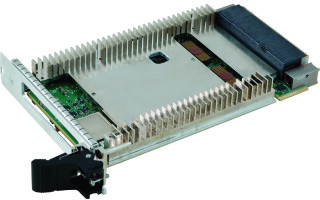
PRODUCT OF THE WEEK: New Wave Design’s V3211 QMC, Small Form Factor SOM with AMD Versal technology
Sponsored StoryFebruary 09, 2026
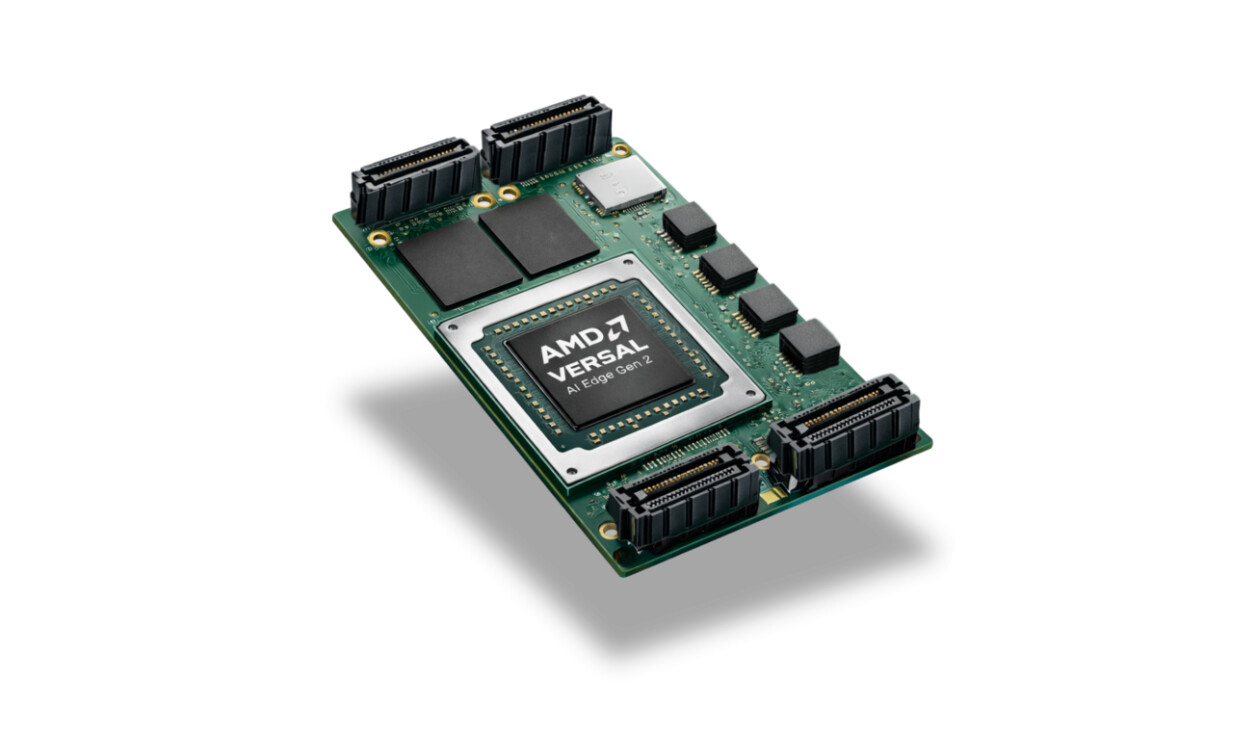
This week’s solution, the New Wave Design V3211 QMC SOM [system-on-module], leverages AMD’s Versal AI Edge second generation Adaptive SoC [system-on-chip]. The module is targeted at high-bandwidth interface applications where data is processed or pre-processed locally and then distributed to carrier-card and backplane interfaces. Military applications for the V3211 include radar, electronic warfare (EW), signals intelligence, video, autonomous systems, and more.
AMD Versal Advantage
AMD's Versal AI Edge Series Gen2 is designed to offer a "single-chip intelligence" solution for heterogenous and artificial intelligence (AI)-driven embedded systems. Its primary differentiator is the integration of multiple distinct processing architectures into a single chip.
This part set features an Arm CPU complex, Mali GPU, FPGA [field-programmable gate array] fabric, image/video processors, and AI inference accelerators all tied together with a high-bandwidth network on chip to seamlessly move data between processing elements. This architecture reduces the need for multichip solutions, such as systems with separate FPGA boards, CPU boards, and GPU boards. For AI-centric systems, this solution provides preprocessing, AI inference, and post-processing, all on a single SoC.
By leveraging the Versal hard silicon Ethernet interfaces, PCIe controllers, DMA engines, and associated software drivers AMD has enabled a robust ecosystem for high-bandwidth Ethernet performance. In addition to the Ethernet interface, the FPGA fabric provided within the adaptive SoC part is capable of hosting New Wave Design IP cores for Fibre Channel, ARINC-818, sFPDP, Aurora, and others. This advantage enables the to be an ideal hardware platform for mixed interface protocol needs or protocol bridging applications.
VITA 93
Leveraging the VITA 93 (QMC) open technology standard, the V3211 SOM is configured in double-width QMC dimensions, targeting applications where affordable small-form-factor computing is required. Combining VITA 93 with the Versal AI Edge Gen2 Adaptive SoC (Versal 2VE3858) or Prime Gen2 (2VM3858) enables a wide set of embedded computing use cases including drones, munitions, air-launched effects, packable EW, and ground vehicle computers.
The V3211 is also deployable into VNX+, 3U/4U/6U VPX, PCI, CompactPCI and most any other carrier card system. In this arrangement, carrier-card CPUs/GPUs are unburdened of the data interface overhead and can be dedicated to running high-value applications and algorithms with the V3211 performing dedicated compute acceleration functions. The QMC SOM form factor and rugged design of the V3211 can, for example, turn a VNX+ based single-board computer into a single-slot heterogeneous computing solution.
Key Features
- Rugged iTemp double-width QMC SFF mezzanine
- AMD Versal Gen 2: 2VM3858 (Prime), 2VE3858 (AI Edge)
- Two banks of 32 GB (64 GB total) up to 3200 MHz/6400 Mbps LPDDR5 SDRAM.
- Four PS electrical high-speed lanes with dedicated CPM5 PCIe Gen5x4 controller.
- Sixteen PL GTYP electrical high-speed lanes suitable for 1G to 32G networking and PCIe Gen4/Gen5 interfaces.
- As many as to 24 LVCMOS 3.3V PS+PL GPIO
- PL hard silicon in Versal Adaptive SoC device:
- 4 x PLPCIE5 3 x MRMAC 3 x ISP
- Thermal sensors for monitoring card temperature
- Robust FPGA example design with board support package (BSP)
For more information, visit the V3211 product page here, the WC31DH chassis page here, or visit the company’s website, or follow the links below.
Resources:
- To view the V3211 data sheet, click here.
- To view the V3211 block diagram, click here.
- To learn more about New Wave Design’s VPX products, click here.
- To learn how New Wave Design enables a modular open systems approach (MOSA), click here.
- For sales information, click here.