Future-proofing military servers for AI advancements
StoryFebruary 06, 2026

Jeffery Dixon
Crystal Group
Defense organizations must balance long-term durability with rapid artificial intelligence (AI) innovation. While military servers are built for decades of service, AI processors evolve on cycles measured in years, risking premature obsolescence. Future-proofing requires modular, scalable architectures that allow component upgrades without redesigning ruggedized chassis. Thermal and power challenges grow as next-generation central processing units (CPU) and graphics processing units (GPUs) exceed 600 watts, demanding adaptive cooling and power systems within strict military-standard limits. Close vendor partnerships and alignment with technology road maps are essential to ensure longevity. By combining modular design, scalable cooling, and vendor collaboration, defense programs can sustain mission-ready AI performance across evolving hardware generations.
Defense organizations face an artificial intelligence (AI) race that will keep pushing the limits of military server performance. They must field ruggedized computing systems that last for decades, yet those systems must also keep pace with AI technologies that evolve on refresh cycles measured in months. While commercial data centers can replace servers every two to three years, military programs require stability, long-term support, and proven reliability under extreme conditions.
As AI becomes central to modern defense, powering everything from autonomous vehicles to real-time threat detection, the challenge intensifies. AI processors and graphics processing units (GPUs) are advancing so rapidly that hardware often becomes commercially obsolete in less than five years.
Future-proofing ruggedized servers is no longer just about physical survivability. It requires designing modular, flexible, scalable architectures that can absorb generational shifts in hardware without compromising security, mission readiness, or environmental resilience.
AI’s rapid evolution versus defense life cycles
AI is reshaping both battlefield operations and the design criteria for military-grade computing. Faster CPUs, more powerful GPUs, and increasingly complex AI models drive compute demands to unprecedented levels. However, the defense industry’s procurement model is fundamentally different from the commercial sector.
Commercial applications typically face two- to three-year refresh cycles that are driven by cost-performance optimization. In contrast, defense applications are usually designed for 10- to 20-year deployments and require ruggedization, strict certification, and life cycle support. Long-term component availability is a key consideration. If a key CPU or GPU becomes unavailable, mission readiness is threatened. In addition, military AI deployments must adhere to rigorous compliance and security standards, which complicates frequent upgrades.
Designing for longevity requires chassis modularity
Designing modular, scalable architectures is one of the most effective ways to ensure long-term capability. Chassis design should remain constant across multiple hardware generations. This approach makes it possible for systems to transition from legacy Intel and AMD processors to the newest Intel Xeon 6 and AMD EPYC 9005 processors, without requiring a new chassis design. Internal rearrangements may be needed, but the overall mechanical footprint stays consistent. Since the form factor remains PCIe-compliant, the same chassis can support newer generations with minor thermal modifications.
The PCIe slots remain an industry standard. Cooling may need to adapt, but the chassis doesn’t need to change. This strategy enables defense systems to accommodate multigeneration upgrades while maintaining physical ruggedization and environmental certification.
Thermal management is the biggest engineering hurdle
While physical form factors remain relatively stable, thermal and power requirements are scaling dramatically: Earlier-generation processors operated at 105 to 150 watts, but today’s AI-class CPUs and GPUs consume 350 to 600 watts each. That trend continues to accelerate.
Maintaining military-standard (MIL-STD) thermal compliance (often -40 °C to +55 °C) in sealed, rugged enclosures is a challenge. The systems must provide quiet operation in acoustic-sensitive applications while balancing thermal performance with power availability in constrained environments like ships, armored vehicles, or remote bases.
Solutions to the heat issue include:
- Using custom ducting and heat pipe technologies to spread loads.
- Reducing GPU clock speeds to lower thermal design power (TDP) in exchange for quieter operation.
- Designing scalable cooling systems that can adapt to future higher-wattage processors.
Today, it’s common to see 350-watt CPUs and 600-watt GPUs. Engineers need to identify a sweet spot of rugged performance without compromising mission requirements.
Leveraging vendor partnerships for road map alignment
Future-proofing depends heavily on vendor alignment. Close relationships with Intel, NVIDIA, Supermicro, AMD, and Micron can provide early access to product road maps. This road map integration steers defense customers toward hardware that will remain supported for years. Every system is customized to the customers’ requirements.
Another cornerstone of future-proofing is designing servers with headroom for future expansion. For instance, unused expansion slots enable customers to add accelerators later. Rack-mounted servers maintain consistent faceplate and chassis dimensions, even as internal layouts shift and embedded rugged servers are becoming more popular for deployed, sealed environments, expanding design options beyond traditional racks.
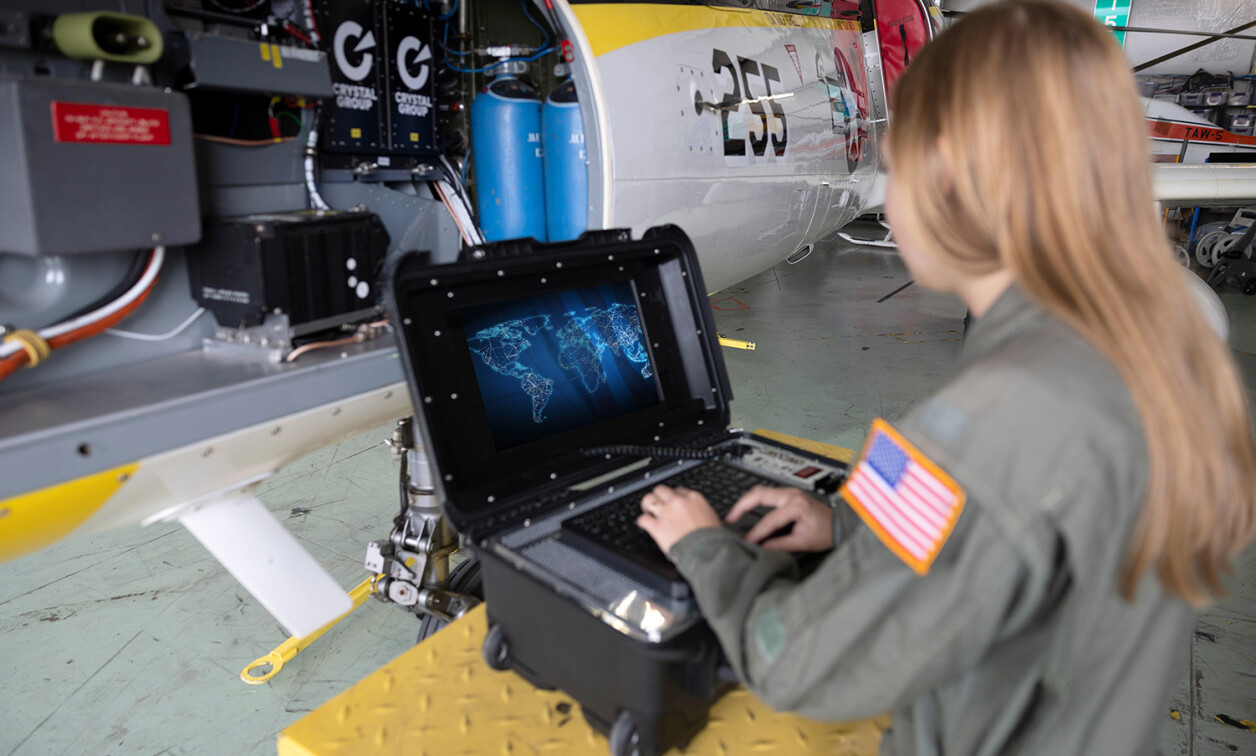
Future-proofing ensures defense teams can integrate new GPUs, field-programmable gate arrays (FPGAs), or application-specific integrated circuits (ASICs) as requirements evolve without needing to redesign the entire system. Instead of mass-producing chassis in bulk, an approach that builds systems aligned with the road maps of key technology vendors and the specific needs of defense integrators has proven successful. (Figure 1.)

[Figure 1 ǀ Successful future-proofing employs an approach that builds systems aligned with the road maps of allied technology vendors and the specific needs of defense integrators. Stock image.]
Dynamic chassis design enables the chassis depth and architecture to be adjusted for each customer’s compute density and cooling requirements. Predictive adaptation for power requirements and thermal subsystems comes about by aligning with vendor road maps, which enables military users to stay current with AI advancements while still fielding rugged systems with long-term operational stability.
Balancing power, heat, and acoustic constraints
The three greatest engineering challenges in AI-driven military servers are power, thermal load, and acoustic requirements. These factors intersect in complex ways.
More powerful chips require larger power supplies and generate more heat. The resulting high thermal loads require faster fans or liquid cooling, which can increase acoustic signatures or add. However, quiet operation is critical in many military applications, limiting how aggressively systems can be cooled.
Engineers must strike compromises that include power-limiting GPUs when full performance isn’t required, designing modular power distribution boards to handle future high-wattage components and trading slight acoustic increases for thermal reliability.
These problems all run into each other – more power, more heat, and the need for quiet operation. Balancing those factors is where engineering expertise comes in.
Future-proofing in practice
To illustrate, consider a rugged 2U server fielded with NVIDIA V100 GPUs. Within a few years, the program requirements will shift toward Blackwell GPUs. Thanks to consistent PCIe form factors, the new accelerators can be integrated without changing the chassis – only cooling ducts and power supplies need to be adjusted.
Meanwhile, Intel’s Xeon processors can be upgraded across generations while retaining the same socket packaging, ensuring that defense agencies can refresh compute power without a complete redesign.
This combination of consistent packaging, modular chassis, and scalable thermal designs enables systems to evolve across decades without premature obsolescence.
Looking ahead: what future-proofing means for defense
Future-proofing military servers is an ongoing process, shaped by both AI’s exponential growth and the unique demands of ruggedized deployments. The path forward will require:
- Advanced cooling innovations to manage greater than 1,000-watt accelerators in sealed environments.
- Edge-computing architectures to reduce dependence on centralized data centers.
- Close vendor collaboration to ensure defense programs align with technology road maps.
Future-proofing military servers is no longer a matter of ruggedization: In the AI age, it means designing for adaptability. By integrating modular chassis, scalable power/cooling, and vendor road map alignment, defense organizations can deploy servers that not only survive harsh environments but also evolve along AI technology for decades.
Jeffery Dixon, systems architect at Crystal Group, is a retired Marine Corps Reserve Lt. Col. with more than 25 years of service in defense systems engineering and leadership. He has held senior engineering roles with major defense contractors and holds an M.S. in systems engineering from the Naval Postgraduate School and a BSEE from the Virginia Military Institute.
Crystal Group www.crystalrugged.com