GUEST BLOG: Drone warfare and Launched Effects
BlogJanuary 29, 2026

Ray Alderman
VITA Standards Organization
WARFARE EVOLUTIONS BLOG. Now is a good time to add some new words to your vocabulary: Launched Effects (LE). The war in Ukraine started in February 2022 and has developed into a new form of warfare with drones. Ukraine has launched as many as 9,000 drones at Russian positions in one day, and Russia has launched as many as 6,400 drones in one day at Ukrainian positions. About 75% of the casualties and equipment destroyed in Ukraine have been attributed to drones. Ukrainian drones have flown as far as 1,500 miles to hit targets inside Russia. Russian drones have traveled as far as 1,000 miles to hit targets inside Ukraine.
The U.S. Army was using some primitive drones back in 1960s, to identify targets for bombing in North Vietnam. So, the Ukraine war developments inspired them to dust off their memories and start-up a new drone program, and they named it “Launched Effects” (LE) in October 2023. The program includes launching drones from manned platforms like tanks and combat vehicles (ground), from helicopters (air), and from landing ships (sea….yes, the army has a fleet of small boats). LEs are made up of an unmanned aerial vehicle, an effects payload, a mission system, and some support systems.
Now, let's talk about what these drones can do, their missions. The Army will have drones with electro-optical sensors (cameras), infrared sensors (heat detectors), chemical detectors (chemical warfare warnings), radioactivity detectors (radiological warfare warnings), acoustic sensors (sound), electronic warfare (EW) systems, SIGINT (signals intelligence) systems, communications relay systems (COMM), and a few will have small low-power radar sensors. These will accomplish ISR missions (intelligence, surveillance, and reconnaissance).
Another series of small drones will carry warheads, explosive munitions, for attacking targets. All these drones can operate autonomously or semi-autonomously, independently or cooperatively. Ukraine has destroyed more than 500 Russian tanks and more than 8,000 Russian ground vehicles with explosive drones in 2025 alone. Those big loses forced Russia to pull their tanks back from the front lines in April 2025.
To read more Warfare Evolution Blogs by Ray Alderman, click here.
Next, let’s look at the range of these platforms. The Army has divided-up the spectrum for their drones nicely. LE-SR (launched effects-short range) are small drones with a range of 25 miles (40km), mainly for use by infantry troops. LE-MR (medium range) go out to 62 miles (100km), for the artillery folks. LE-LR (long range) drones go out to 250 miles (400km) for the helicopter guys. And, LE-ULR (ultra long range) drones go out to 1,000 miles (1600km) for the missile guys.
At least that's how I see the spectrum divisions. The objective of launched effects is to push the battle lines all the way back to the enemy’s rear, where his command, control, communications, and supplies are located. LE-SR drones can push the line back further than a bullet can travel. LE-MR drones can push it back further than artillery shells can hit. LE-LR drones can push it back further than helicopters can attack, And, LE-ULR drones can push it back further with missiles. Look at launched effects as a layered attack strategy.
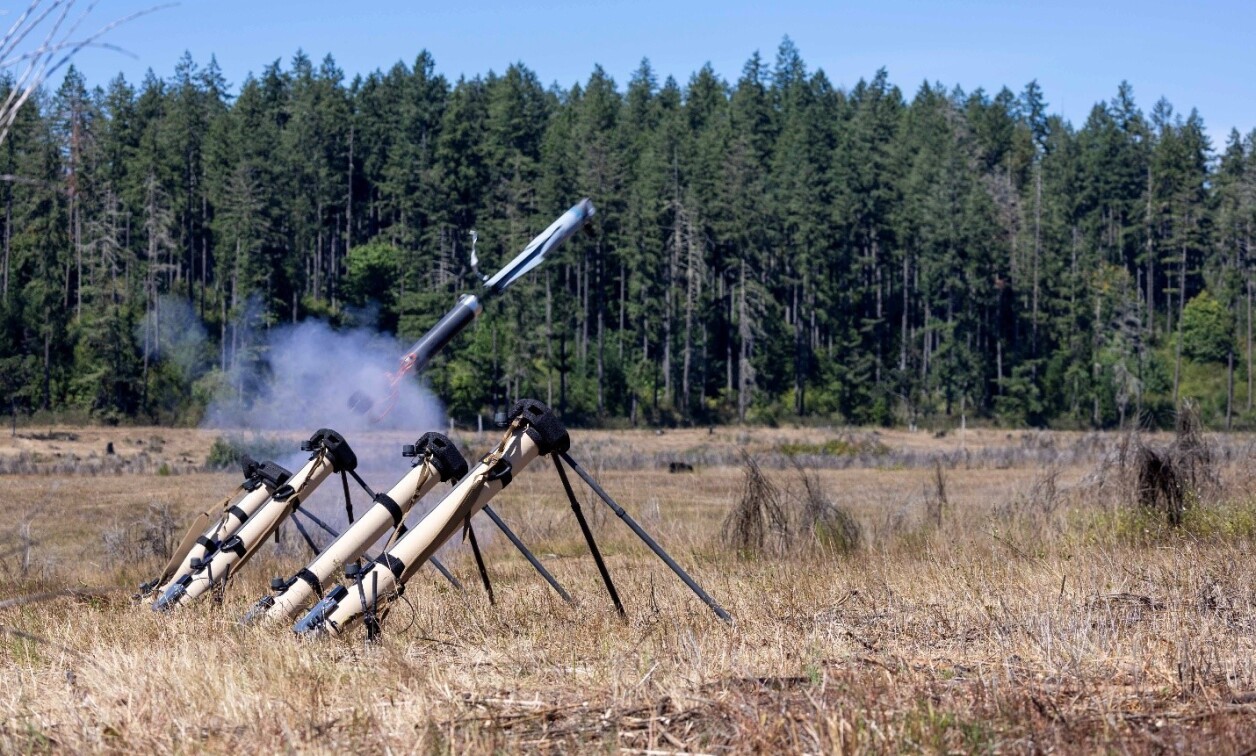
The U.S. Navy is playing with their version of LE called MLE (Maritime Launched Effects). They will be integrating small ISR and explosive drones into their CCM (Combatant Craft Medium) used by special operations forces. The Air Force is working on their ALE (Air Launched Effects), starting with their CCA (Collaborative Combat Aircraft) loyal wingman program. They are also looking at dumping hundreds of LE drones out the back of C-130 cargo planes, for swarm attacks against enemy installations on the ground. The Marines are doing some similar programs like the Army. In January 2026, the Marine Corps will start integrating ground-launched explosive drones into their forces under their OPF-L program (Organic Precision Fires-Light). The drones have folded wings with a launcher that looks like a mortar tube. And, the Space Force works with the other services, to provide COMM links and GPS for the small drones flying around the battlefield. Not much need for small drones in space.
Looking back in history, it was the CIA that flew the first MQ-1 Predator drone in Albania in 1995. From there, it was the CIA that fired the first missile from an MQ-1 Predator, killing al-Qaeda commander al-Harethi in Yemen in 2002. The CIA turned the Predator missions over to the Air Force around 2013, keeping some missions under their control. Today, the CIA operates both ISR and armed Reaper MQ-9 drones. The size of their fleet is classified. The 360 MQ-1 Predator drones that were built were retired in 2018, replaced by the MQ-9 Reaper. So far, about 1,200 Reapers have been built. For the smaller LE drones, the Pentagon wants 300,000 drones right away. The U.S. Army plans to buy 1 million LE drones over the next 2 or 3 years. Today, Ukraine is building about 200,000 small LE drones per month. European NATO countries are trying to decide how many they want. So are Asian countries Japan, Australia, Taiwan, and Philippines.
When you read about Launched Effects, you will be reading about unmanned aerial vehicles (UAVs). You won’t see much about unmanned ground vehicles, unmanned naval surface vessels (USVs), or unmanned underwater vessels (UUVs). The technology, the missions, and the operations for those platforms are unclear compared to what UAVs can do at this point.
If you read “The Kill Chain” by Christian Brose, you will learn that the U.S. military has been buying small numbers of large, expensive, complex, hard to maintain, manned platforms. that the big defense contractors love to build. What the Ukraine war is proving is that we need to buy large volumes of small, simple, inexpensive, expendable, easy to maintain, unmanned platforms that smaller technology companies love to build. Ukraine is proving that we need to buy results on the battlefield, not snazzy features on big flashy platforms. The Launched Effects programs seem to be moving us in the right direction. Drones have already revolutionized some elements of warfare on land, in the air, and on the sea.
Now, you have a basic understanding of Launched Effects programs, what they do, and how the services are deploying them. As artificial intelligence matures, we will see more advances in drones used autonomously on land, in the air, on the sea, and under the sea. These developments lead us to the obvious next topic: counter-unmanned aerial systems (C-UAS). What the enemy puts in the air, we need to shoot down.