Autonomous "Grand Challenge" program from DARPA reaching endpoint
NewsJanuary 19, 2026

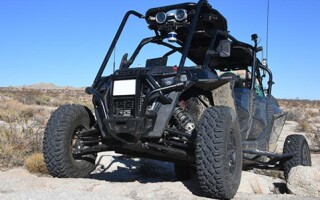
ARLINGTON, Va. Following 20 years of high-level innovation and testing with U.S. Army and Marine Corps partners, the U.S. Defense Advanced Research Projects Agency (DARPA) Grand Challenge -- a first-of-its-kind race to foster the development of self-driving ground vehicles -- is nearing its conclusion as the Robotic Autonomy in Complex Environments with Resiliency (RACER) program gets ready to wrap up.
According to a recent update from DARPA, the RACER effort was never about building a single, specialized vehicle but was instead intended to develop an autonomy "stack" – a collection of algorithms, datasets, and neural network models that could be deployed on any ground vehicle. Since the RACER program first began in 2021, as part of the Grand Challenge, users can now apply the RACER-developed stack to any vehicle -- as long as it's equipped with appropriate sensors -- turning that vehicle into an autonomous machine capable of operating in challenging off-road environments, independent of GPS or premapped routes, at mission-relevant speeds.
In a series of final tests, demonstrations, and experiments in the last quarter of 2025, RACER vehicles demonstrated the ability to navigate complex terrain without human intervention, thereby freeing up soldiers for other critical tasks.
“RACER isn't just about replicating existing military capabilities.” said Stuart Young, DARPA RACER program manager, “It's about fundamentally reimagining how missions are executed.”
The effect of the RACER program extends beyond the battlefield, according to the DARPA update: With the development of dual-use technology, RACER has sparked the interest of both the U.S. Department of Defense (DoD) and the private sector, which has enabled other companies to invest in similar technology and to help bridge the government/private product-development gap. Multiple companies have grown out of the RACER program, helping to build a market for off-road ground vehicle autonomy, including Field AI, which spun out of DARPA-funded research at NASA’s Jet Propulsion Laboratory; and Overland AI, emerging from research at the University of Washington Robot Learning Laboratory.
For private equity firms, RACER presents a unique opportunity to capitalize on proven and adaptable technology, as the DARPA update notes that the core autonomy stack is readily transferable to commercial applications in industries like agriculture, construction, mining, and transportation.
“Now that the RACER program is ending, there is a lot of commercial opportunity for private equity,” said Young. “It's time for both military users and private investors to recognize the transformative potential of RACER and embrace a future where autonomous systems are not just a possibility, but a reliable and integral part of our world.”