Adm. Bradley: Operation resulting in seizure of Venezuela's president marks new standard for SOF
NewsMay 19, 2026

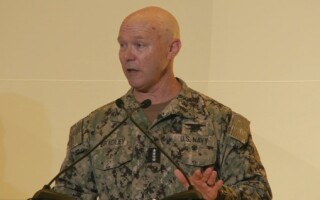
TAMPA, Florida. The January seizure of Venezuelan President Nicolás Maduro during Operation Absolute Resolve has set a new benchmark for how U.S. Special Operations Forces will operate in future conflicts, said U.S. Navy Adm. Frank M. Bradley, commander of U.S. Special Operations Command (USSOCOM), during his keynote address at SOF Week 2026.
Operation Absolute Resolve, conducted in the early hours of January 3, resulted in the seizure of Maduro and his wife and their transfer to the United States. Bradley called it a defining moment for the command.
"On the night of January 3, the world watched as Operation Absolute Resolve unfolded," Bradley said. "It has been, is, and will be the most sophisticated integrated interagency joint force raid ever conducted.
"It has defined a new standard for power projection," he continued. "That is the future of what SOF operations will look like."
Bradley framed the operation within a broader argument about how SOF must evolve its relationship with the joint force -- not as a peripheral capability called upon for discrete missions, but as the connective tissue at the center of complex, integrated operations. He outlined three functions SOF uniquely provides: framing problems through placement and access in ambiguous environments; pathfinding innovation and serving as what he called "a risk absorber for the joint force"; and building the relationships and teams that hold joint efforts together.
"SOF's value is not what we do instead of the joint force, but what we do with the joint force," he said.
He also addressed the rapidly changing character of the battlefield, pointing to the fusion of ubiquitous surveillance and commercially available technology as a defining feature of modern conflict. He described the passive digital environment that already surrounds every person -- the network infrastructure that logs a device's MAC address and triangulates its position to serve advertisements -- and warned that adversaries are applying that same commercial infrastructure to targeting.
"The battlefield is characterized by speed and surveillance today," Bradley said. "We now fight in a space of pervasive surveillance, an ubiquitous information environment. It is no longer the guarded property of government -- it is increasingly crowdsourced, exploitable."
That digital footprint, he warned, becomes a gridpoint for precision munitions in a contested environment.
On the munitions side, Bradley argued that the proliferation of lethal systems beyond state control -- noting that a capable drone can now be acquired for roughly $500,000 -- demands a new kind of mass. He called for "abundant, attritable, scalable systems" capable of generating compounding effects through creative layering of kinetic and non-kinetic capabilities, including electronic warfare.
Bradley closed on a note of institutional confidence, describing a networked SOF force that presents adversaries not with an opportunity but with a wall.
"Peace through strength is deterrence -- that is the work we do every day," he said. "I am incredibly optimistic about our nation's future."