How holographic 3D radar technology can improve C-UAS efforts
StoryMay 13, 2026

Flavia Camargos Pereira
Military Embedded Systems
The proliferation of uncrewed aerial systems (UASs) across every theatre of operations has become an increasing concern for military services worldwide, as UAS maneuverability and capacity to fly low, through the trees, and around buildings challenge detection systems, putting defense installations and facilities at risk.
In order to address this capability gap, Spotter Global -- a Utah-based supplier of real-time situational awareness capabilities for perimeter surveillance, security, and protection, -- is relying on the use of holographic 3D radar technology instead of electronically scanned array (ESA) methods.
The company is set to showcase this technology at the upcoming SOF Week 2026 exhibition, set to be held May 18-21 in Tampa, Florida.
Its GAX500-3D radar, powered by the Spotter Global Compact Holographic 3D (CH3D) radar technology, was designed to provide 100%-of-the-time coverage on all targets.
According to the manufacturer, it scans the entire sky thirty-two times faster than legacy ESA capabilities while providing target location in real time.
Spotter Global president and CEO Logan Harris asserts that ESAs work like a flashlight, “focusing the beam to get longer range, and then scanning the beam around, looking for targets.
“That gives you additional range without increasing the overall power consumption. However, the tradeoff is speed. How long does it take you to scan the full volume of space?” Harris said. “One of the biggest problems that the military and other critical infrastructure are facing today is not really long-range, but rather short-range FPV drones.”
This challenge led Spotter Global engineers to construct the GAX500-3D to collect data of 50 targets over the full volume of space every 56 milliseconds instead of the usual 1.8 seconds clocked by ESA solutions. The system can also detect and locate fast-moving swarms of unjammable drones that do not emit radio frequency signals, such as video artificial intelligence (AI)-guided and fiber-optic UASs.
“This holographic radar technology comes into play because it is like a floodlight that illuminates the full volume of space continuously,” Harris notes. “That really differentiates us from these electronically scanned arrays.”
Featuring an ultra-low SWaP-C [size, weight, power, and cost] architecture, the GAX500-3D measures 16.32 by 9.69 by 4.23 inches and weighs less than 4 kg. With a very low transmit power of 3.2 watts, it was engineered to radiate 100 times less energy than regular ESA systems, which emit around 300 watts.
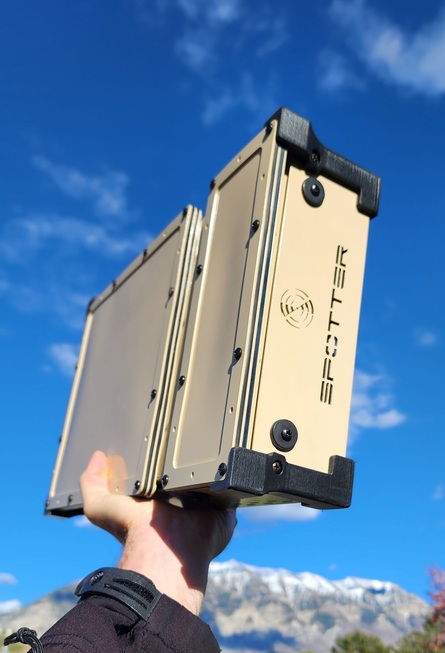
Photo courtesy Spotter Global
Harris states that a critical aspect of defense applications is not to give away your position: “If you can transmit at a low power or a wide area, your energy density is much lower versus putting into a very focused beam that is shining around [and] easy to see.”
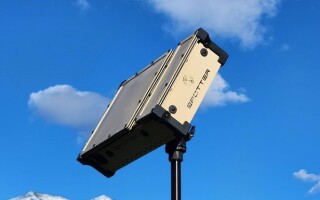
Another of the GAX500-3D's capabilities is filtering environmental noise to deliver clean data and reduce nuisance alarms. The solution can be seamlessly paired with external passive RF/EO/IR for multisensor threat validation. In its basic setup, it is put on a tripod and connected to a laptop, but it is also compatible with standard NATO mounts, roll-cage brackets, and existing vehicle masts.
The GAX500-3D can be integrated onto diverse land platforms, including infantry squad vehicles (ISV), the multiservice Joint Light Tactical Vehicle (JLTV), the U.S. and allied nations' Family of Medium Tactical Vehicles (FMTV), and the U.S. Army and allied Heavy Expanded Mobility Tactical Trucks (HEMTT).