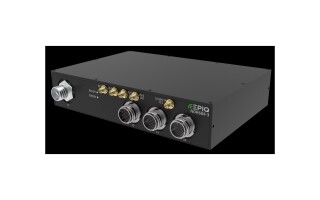
Organizations ratify ANSI/VITA 90 VNX+ Enhanced Small Form Factor System
NewsFebruary 19, 2026


February 19, 2026. VITA, the trade association governing open standards computing architectures for critical and intelligent embedded-system industries, announced the ratification of the ANSI/VITA 90.x‑2026 (VNX+) family of standards by ANSI and VITA. This milestone formally introduces VNX+ as the next‑generation Enhanced Small Form Factor (eSFF) system architecture.
According to the VITA announcement, the VNX+ standards address the growing demand for improved size, weight, and power (SWaP) efficiency in rugged, low‑cost, high‑speed serial fabric–based plug‑in modules (PIMs). VNX+ builds on the foundation of the VITA 74 VNX standard to enable markedly higher performance, expanded system versatility, and enhanced mechanical robustness while maintaining compatibility with the established VNX mechanical framework.
Optimized for compact, conduction‑cooled embedded systems, the VITA organization announcement asserts that VNX+ introduces advanced high‑speed signaling capabilities and eliminates airflow paths over PIMs, thereby improving reliability in harsh environments and positioning VNX+ as a key enabler for next‑generation high‑performance embedded computing including industrial automation, aviation, ground vehicles, naval systems, space exploration, and emerging wearable technologies. The primary goal of VNX+ is to meet the demanding embedded-computing requirements of command, control, computers, communications, cyber, intelligence, surveillance, and reconnaissance (C5ISR) applications.
“The ratification of VNX+ marks a pivotal moment in embedded systems technology and enhanced small-form-factor system design,” said David Givens, VITA 90 Working Group Chair and Industry Standards VP at Samtec. “The family of VNX+ standards empowers embedded developers to push the boundaries of what’s possible in rugged, high-performance environments, unlocking new frontiers in aerospace, defense, and beyond.”
The VNX+ family includes a series of “dot” standards that define additional interface profiles and practices which ensure interoperability across diverse applications. These standards layer specific slot & module profiles, coaxial and optical interconnect options, advanced power filtering and conversion, energy‑storage technologies, and advanced mounting and cooling practices. Additional ancillary standards are currently under development within the VITA 90 Working Group.
“The new VNX+ eSFF standards reflect a decade of closed‑loop, evidence‑driven refinement processes where electrical, mechanical, thermal, and ecosystem considerations evolve together” said Bill Ripley, VITA 90 Working Group Co-Chair and Technical Consultant-Evangelist at Trident Infosol. “The standard matures through generational cycles of prototype → test → evaluate → revise, with each generation incorporating lessons from modeling and simulation, hardware development, interoperability trials, and integrator feedback.”
The following VNX+ standards have been released:
- ANSI/VITA 90.0-2026: VNX+ Base Standard
- ANSI/VITA 90.1-2026: VNX+ Profile Tables
- VITA 90.2-2026-VDSTU: VNX+ Optical and RF Connector Modules - Type 2
- ANSI/VITA 90.3-2026: VNX+ Power Supply and Storage Modules
- ANSI/VITA 90.4-2026: VNX+ Cooling and Mounting Systems
- ANSI/VITA 90.7-2026: VNX+ Optical and RF Connector Modules - Type 7
The standards are available for purchase and download at the VITA Online Store (www.vita.com/Standards ).