Achieving technology overmatch with system-on-module embedded architecture
StoryOctober 10, 2025

Rodger Hosking
Mercury Systems

Maintaining technological superiority requires rapid adoption of new commercial technology. System-on-module (SoM)-based designs can address the industry’s critical need for quickly deploying technology to keep pace with evolving requirements and adversarial advancements. SoM architecture can foster faster development, greater adaptability, and cost efficiency.
The rapidly evolving technological landscape in military and defense operations mandates systems that are not only high-performing but also adaptable, cost-effective, and quick to deploy. Military and defense systems are typically subject to stringent requirements, including ruggedness, reliability, real-time performance, and security. System-on-module (SoM) embedded system architectures have emerged as a solution to address these critical needs by offering an embedded subsystem that combines essential components, including processors, memory, communication interfaces, and sometimes data converters into a single compact module.
SoMs are a powerful, efficient, and flexible platform for a range of defense applications, allowing engineers to immediately start application development, port IP, and deploy on traditional and custom form factors. This flexible integrated approach is ideal for advanced defense applications including electronic warfare (EW), surveillance, radar, drones, and communication systems.
Meeting critical needs
SoMs are designed to meet military-grade standards for temperature tolerance, vibration resistance, and electromagnetic compatibility, ensuring that they perform reliably even in challenging situations. Many defense applications, such as radar or missile guidance systems, require real-time data processing. SoMs, often equipped with FPGA [field-programmable gate array] processors, offer the necessary computing power for fast data analysis, decision-making, and system control.
Because of their small size, SoMs support major initiatives to move these capabilities closer to the edge, often directly behind the antenna. By reducing weight, and power (SWaP) as well as cost, SoMs are highly appropriate for drone, aircraft, and mobile applications.
Speeding deployment of new technology
For the defense sector, timely delivery of new technology is often critical, especially in scenarios where technological superiority plays a decisive role. Traditional systems that involve custom designs and extensive testing can take years to develop. For example, several new families of direct RF devices combine multiple wideband ADCs and DACs [analog-to-digital converters and digital-to-analog converters] capable of digitizing RF signals up to 36 GHz with FPGAs containing powerful vector processors and artificial intelligence (AI) engines. Housed in a single ball-grid-array (BGA) package, they also sport onboard Arm processors to control operations. These devices perform RF signal acquisition, real-time processing, and generation to notably extend the performance levels of military radar, EW, and communications systems.
However, because the BGA array pins of direct RF devices are so tightly spaced, designing them into products requires significant engineering effort. The numerous wideband analog RF signals must be shielded from multiple high-current switching power supplies, and hundreds of digital gigabit serial signals for SDRAM, 100 GbE, all operating within the same frequency band. Extensive signal-integrity (SI) analysis modeling is essential for circuit board signal and shield traces, layer stack-up, and ground plane geometries to optimize crosstalk, impedance, differential skew, and dynamic range. For such extreme design complexity, SI analysis must often be iterated several times before performance objectives are met.
One major advantage of SoM architectures is that once SoM circuit board design goals are verified at the SoM signal connectors for analog RF, clocks, and digital I/O, the SoM can be installed on a carrier board to bring those signals to the required signal connections of the system. Designing a carrier board is comparatively simple, because all of the critical work of properly protecting BGA pin signals of the direct RF device has already been optimized within the SoM. This customizability enables defense organizations to select the right SoM for specific missions, whether it be for tactical communication systems, sensor networks, or autonomous vehicles.
SoMs enable defense industry engineers to quickly prototype new systems by selecting SoMs that are already thoroughly tested and validated. These modules can be integrated into new systems with minimal design complexity, notably reducing development time. This capability enables the faster rollout of cutting-edge technology, so that military missions can take advantage of the latest innovations to maintain defense superiority.
Lowering acquisition costs
With defense budgets under increasing scrutiny, cost control is essential not only for military organizations, but also for contractors competing for design wins. SoMs help reduce costs in several ways, making them an attractive choice for defense applications.
SoMs enable military contractors to take advantage of economies of scale. Because SoMs are often produced in larger quantities, production volumes provide cost savings that are passed on to defense organizations. This cost reduction is critical, especially when developing large-scale systems such as fleets of drones or extensive surveillance networks. Phased-array antenna systems require independent channels for each element, further emphasizing the importance of reducing SWaP and cost per channel.
Instead of developing new products from the ground up, manufacturers can leverage existing SoM platforms and focus their efforts on integrating the modules into specific defense systems rather than developing entire architectures from scratch. Software and firmware development costs traditionally account for a major portion of new product engineering.
Because SoMs usually represent the core technology of the derivative carrier products, their existing firmware, software, FPGA code, and high-level APIs are all highly reusable, greatly reducing overall engineering costs.
For similar reasons, qualification testing of SoM-based products is streamlined by borrowing heavily from the test procedures for the functional, security, reliability, and environmental requirements already established for the SoM, usually the most complex portion of the product.
The integration of SoMs also helps reduce ongoing maintenance costs. Since the modules are pre-validated and reliable, the likelihood of system failures is reduced. Additionally, the modular nature of SoMs means that replacing or repairing faulty components is often simpler and far more cost-effective than repairing complex non-modular, custom-designed systems.
Putting SoMs to work
As a Xilinx early access partner, Mercury developed its Quartz SoM mezzanine card, performing three iterations of signal integrity analysis to optimize all signal performance metrics. The company’s family of 14 Quartz SoM carrier products adds a 3U SOSA-aligned VPX card, a PCIe card, two small-form-factor subsystems, and a ruggedized weatherproof enclosure, shown in Figure 1.
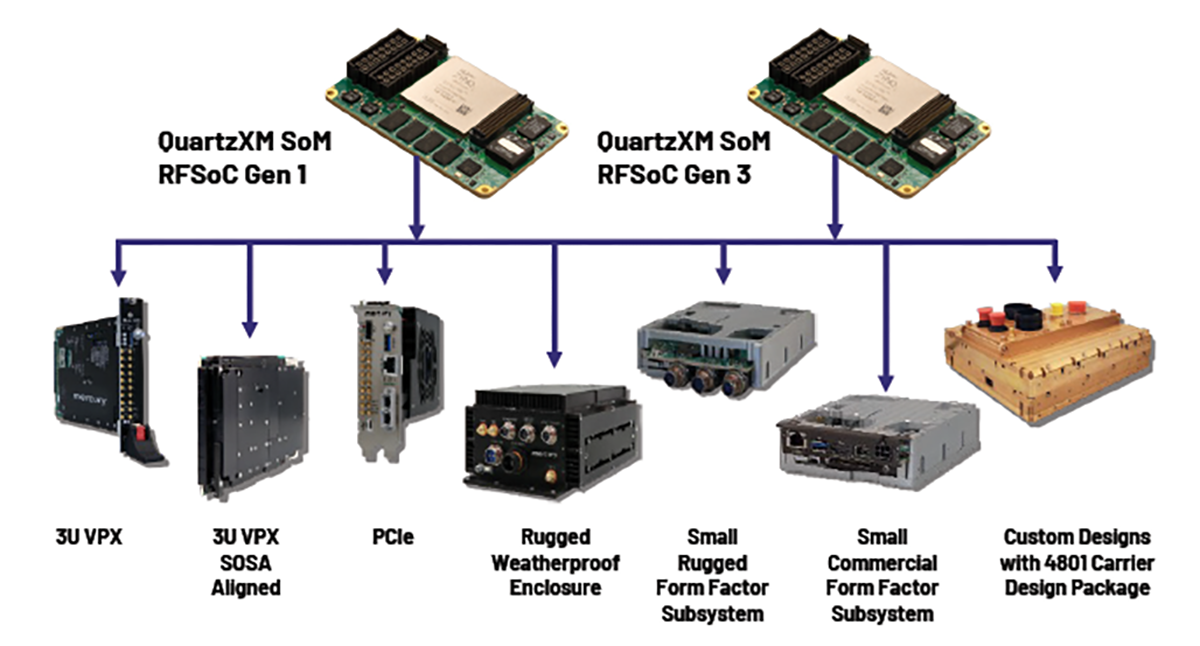
[Figure 1 ǀ The Quartz family of SoM architecture products for AMD Xilinx RFSoC Direct RF FPGA include two SoMs on top, and seven derivative SoM products, including custom designs enabled by the 4801 SoM Carrier Design Package.]
The Quartz SoM-based products can digitize 2 GHz of instantaneous signal bandwidth for transceiver applications including multi-channel phased array systems for radar, EW, communications, signals intelligence, and countermeasures.
Mercury also offers the Agilex 9 product family based on Altera’s Agilex 9 Direct RF SoC FPGA Series sporting 64 GS/sec 10-bit ADCs and DACs, Agilex 9 FPGA resources, and multiple ARM processors. The Agilex 9 ARGW014 device features four ADCs and DACs, while the AGRW027 device features eight ADCs and DACs and roughly twice the FPGA resources of the former device in a larger multi-chip module.
Transforming future mil systems
SoM embedded system architectures address critical needs by offering reliable, rugged, and real-time capable systems. SoMs accelerate the delivery of new technology, reduce costs through modularity and economies of scale, improve interoperability across platforms, and provide the adaptability needed to meet the evolving challenges of modern defense. SoMs will continue to play an increasingly vital role in shaping the future of military technology.
Rodger Hosking is vice president, Mercury Systems Mixed Signal. Rodger has more than 30 years in the electronics industry and is one of the co-founders of Pentek; he has authored hundreds of articles about software radio and digital signal processing. Prior to Pentek, he served as engineering manager at Wavetek/Rockland, and he holds patents in frequency synthesis and spectrum-analysis techniques. He holds a BS degree in physics from Allegheny College in Pennsylvania and BSEE and MSEE degrees from Columbia University in New York.
Mercury • https://www.mrcy.com/