Edge AI, counter-UAS, open architecture, and thermal tech set the tone at AUSA 2025
NewsOctober 15, 2025


WASHINGTON, D.C. AUSA 2025 put embedded technologies at the center of the Army’s modernization push, with show floors and keynotes converging on themes of counter-UAS, edge artificial intelligence/machine learning (AI/ML), open architectures, thermal management for high-power compute, and resilient radio frequency/positioning, navigaton, and timing (RF/PNT).
Exhibitors emphasized modularity and deployability across vehicle, soldier-borne, and small-UAS form factors, while Army leadership underscored faster acquisition cycles and field-driven iteration.
Counter-UAS and layered defense
Directed energy, electronic attack, and autonomy was heavily discussed and featured at the show, particularly when it came to counter-UAS. Leonardo DRS displayed a Stryker-mounted system that combines a high-energy laser with kinetic and non-kinetic defeat options for Group 1-3 drones, integrating sensors and onboard effectors on a single mobile platform, the company says. A separate DRS announcement highlighted a first-place finish in a DoD counter-drone event with its Ring C-UxS RF-based electronic-warfare system designed to detect, identify, and defeat small uncrewed aerial systems.
GA-EMS, meanwhile, showed Fencepost, a passive acoustic surveillance system that the company reports detected low-signature aerial threats during a T-REX 25 exercise and is aimed at congested RF environments where radar and optical sensors can be constrained, the company says. Axon Vision pointed to an AI-based C-UAS capability that automates detection and response while maintaining operator awareness across platforms.
Edge AI, autonomy, and data-to-fires
Not surprisingly, AI was also a big theme at the show, particularly when it came to vehicles and wearables. Palantir’s TITAN concept framed a software-first, modular ground station that fuses multi-domain sensor inputs and applies AI/ML to compress the sensor-to-shooter timeline, with an industry team spanning primes and non-traditionals, according to company materials.
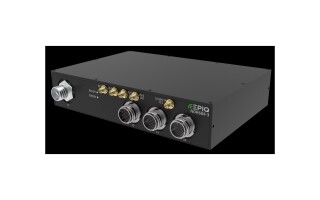
GMS rolled out the X7 Raptor, a compact mission computer targeted at high-volume small UAS, manpack, and wearable use cases; the design focuses on modular expansion via commercial interfaces and SWaP-conscious compute using an Intel Xeon W, the statement reads.
On the munitions side, Rafael’s L-SPIKE 4X “launched effect” blends missile-class propulsion and warheads with loitering profiles out to 40 km, hardened comms for contested EM/GPS-denied operations, and AI-enabled operator aids, the company says.
Human–machine interfaces and soldier systems
Implementing AI is one thing, but getting humans and machines to work together is another, whch is why several companies were focused on linking the two.
Rugged multi-function displays from IEE were framed as the primary HMI for vehicle protection and C-UAS, aggregating radar tracks, RF detection, and optical/thermal feeds on 3D tactical displays to support rapid engagement, the company says. Meanwhile, Kopin previewed soldier-worn AR—including day/night HUDs, MicroLED optics, and an AI-enabled microdisplay prototype—plus head-tracked binoculars aimed at training and simulation, the statement reads.
Sikorsky extended autonomy to heavy lift with the S-70UAS U-Hawk, replacing the cockpit with doors and a ramp and integrating fly-by-wire and MATRIX autonomy to move outsized cargo, deploy UGVs, and launch multiple effects, the company says.
Open architectures and secure processing
Open-standards messaging was prominent. Mercury highlighted secure rackmount and 6U VPX modules aligned with the SOSA Technical Standard, integrating tamper resistance, authenticated boot, and data-at-rest protection alongside its TeraFire crypto platform for CNSA 2.0-level implementations, the company states.
Elma debuted FlexVNX+, a three-slot VNX+ (VITA 90) development chassis aligned with the Sensor Open Systems Architecture, or SOSA, Technical Standard to accelerate bring-up and lab validation of small-form-factor payloads; the platform supports high-speed interconnects and chassis-management options aimed at compact intelligence, surveillance, and reconnaissance (ISR) as well as electronic waqrfare (EW) and wearable communications, the company says.
Elsewhere, One Stop Systems, Systel, and GMS collected Best In Show honors for embedded and rugged computing solutions, including OpenVPX-based security systems, underscoring the importance of modular and upgradable computing at the edge.
Thermal cooling was also an important subject at the show. With AI accelerators and dense CPUs pushing beyond air- and conduction-cooling limits, nVent SCHROFF demonstrated a VITA 48.4 Liquid Flow Through module rated around 300 watts per 6U slot, using sealed, board-specific channels and quick-disconnect plumbing compatible with VITA 48.4 chassis, the company says. Target applications include signal processing, radar, and tactical AI where power density and environmental stresses drive liquid-cooling adoption.
Resilient PNT and RF interconnects
Navigation and communications on the battlefield remains a hot topic. For example, BAE Systems emphasized M-Code receivers across airborne, ground, and weapon platforms with anti-jam and anti-spoof features intended to preserve GPS connectivity under interference, the company says. Times Microwave showcased hermetically sealed MilTech RF/microwave cable assemblies—vapor-sealed, flexible, and vibration-tolerant—for radar, EW, and communications across aircraft, vehicles, and shipboard use, designed for low loss and phase stability under thermal and mechanical stress.
On miniature battlefield connectors, ITT Cannon’s C5 Warrior and ODU’s AMC Series T focused on high-density data (10 Gbps) and multi-locking options for space-constrained soldier, UAS, and smart-weapon electronics.
Policy backdrop: speed to field
It wasn't all about highlighting specific technologies, as Secretary of the Army Daniel Driscoll delivered the keynote to describe the Army's policy focus moving forward for making sure the latest technology reachies soldiers in the field. He described a venture-style capital and acquisition model intended to move prototypes to soldier testing in weeks, paired with competitive pitch events and planned FY26 funding in EW, UAS, and counter-UAS.
Bottom line
Across AUSA 2025, embedded suppliers converged on a common architecture: open-standard compute and interconnects; liquid-cooled, high-density processing; resilient PNT and RF paths; and AI pushed to vehicles, soldiers, and small UAS. Counter-UAS remained the unifying operational driver, with sensing, decision aids, and layered effectors moving closer to the edge.