The military’s real AI revolution is happening in the dirt
StoryJune 16, 2026

Adam Sadilek
AIM (Intelligent Machines)
As the U.S. Department of Defense (DoD) accelerates the adoption of deployable technologies through the expansion of nontraditional procurement pathways, the next step is scaling them. One of these is autonomous earthmoving, which has already demonstrated success in fielding across military branches and training units for effective deployment. Unlike other new autonomous capabilities, the challenge isn’t testing an experimental technology, but rather scaling a proven one.
In 1947, U.S. Navy Admiral William F. Halsey reflected on how the U.S. won World War II with a surprising assessment: “If I had to give credit to the instruments and machines that won us the war in the Pacific, I would rank them in this order: submarines first, radar second, planes third, bulldozers fourth.”
The surprising choice to include bulldozers spotlights a truth about military operations that remains as important today as it was 80 years ago: Defense infrastructure is not optional. The Navy’s Construction Battalions, the legendary “Seabees,” rapidly constructed airfields, ports, and bases for World War II Pacific island-hopping campaign. Without their work in the dirt, the U.S. victory would have come at a higher cost or might have been impossible.
The ability to construct on the battlefield is just as important today as it was for Caesar’s legions that crossed the Rhine. Yet the ability to rapidly build that infrastructure while under contested conditions has lagged behind other advances in military capabilities. Autonomous earthmoving systems have arrived to solve this critical gap. These artificial intelligence (AI)-powered heavy machines aren’t concept vehicles: They are already operational and in use today to clear minefields, rebuild runways under fire, and construct forward bases without risking warfighter lives.
Moving dirt under fire
Recent conflicts demonstrate the immense impact of infrastructure vulnerability; one instance is seen in Ukraine, where destroyed bridges and roads cause repeated disruptions to key operations. Quick construction or repairs of supply routes and runways can prove decisive. However, these are some of the most dangerous military tasks, requiring extended exposure in contested environments.
Technologies, systems, and materials to accelerate unmanned platform development, and autonomous systems to clear or breach obstacles, cross gaps and rivers, improve combat roads/trails, and detect dynamic mobility hazards in complex environments are required across the U.S. Department of Defense (DoD). One example already in wide use is the U.S. Army Engineer Research & Development Center (ERDC), which for several years has conducted research in “Autonomous Robotic Solutions for Engineer Operations in the Deployed Environment.”
Under Agile Combat Employment (ACE), the U.S. Air Force is required to establish and maintain bases in austere and remote locations within the weapons engagement zone of adversaries. This approach will require autonomous systems for infrastructure improvement, construction of defenses, and for airfield and other installation repair during combat operations.
The Army, Navy, and Marine Corps have also recognized that integration of autonomy into heavy equipment (material handling, construction and other ground logistics systems) supports movement of supplies & other logistics, mine and route clearance operations, construction of obstacles and defensive positions, Airfield Damage Repair (ADR), OCONUS construction and associated earthmoving to build airstrips, housing, and bases to support U.S. military logistics, and humanitarian assistance – building and rebuilding infrastructure in nations devastated by war or natural disaster. Being able to automate parts of the logistics “chain” with autonomy allows for fewer soldiers being put in harm’s way.
Autonomous earthmoving is a game-changer and has achieved maturity, requiring immediate fielding at scale to address these types of challenges. These are production systems retrofitted onto existing military equipment that can operate without onboard operators or human oversight – bringing speed and resilience to repairs, construction, and maintenance of infrastructure in hostile environments. Construction tasks that once exposed engineers to fire are now carried out with autonomous equipment, while personnel can direct the operations from protected positions. Runway repairs can proceed continuously through day or night, in the most extreme weather, and in contested or contaminated environments. Powerful AI capabilities conduct rapid damage assessment and create 3D maps of sites, giving commanders real-time status updates while the machines remove hazardous debris and ordnance to return damaged infrastructure to operation more quickly.
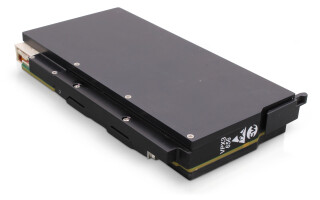
Operating without internet or GPS, these machines are virtually immune to jamming and hacking when traditional systems fail, making them purpose-built for the DDIL environments: a top priority for U.S. military leadership. Autonomy runs locally on ruggedized hardware, using hardened cameras and high-tech sensors that are capable of handling complex terrain reliably while maintaining precision-level accuracy. In fact, performance can exceed that of human operators in most conditions within a short period of time, thanks to end-to-end learning capabilities that enable machines to get smarter with each dig. (Figure 1.)
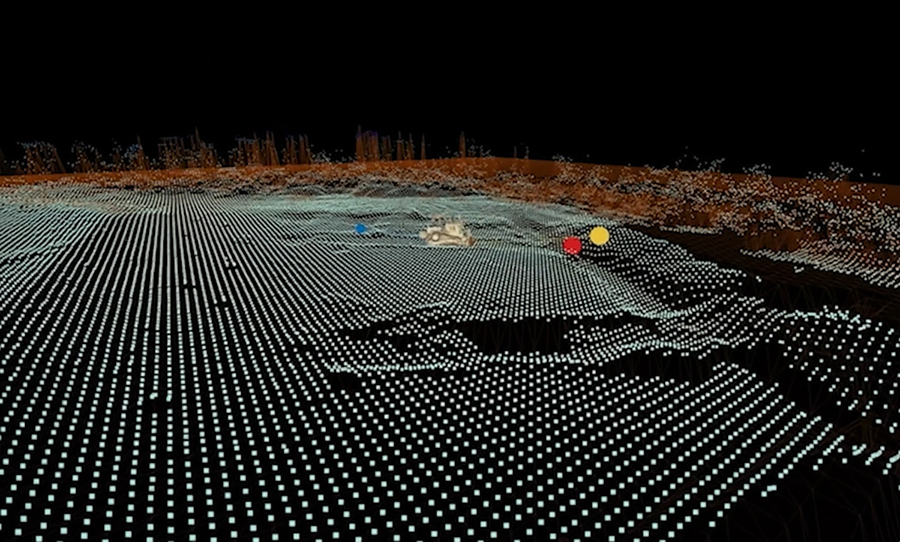
[Figure 1 ǀ An AI-enabled machine uses onboard sensors to generate a 3D map of terrain during training operations. The machine can operate in low- or no-light conditions without GPS. AIM image.]
These capabilities, coupled with the fact that AI doesn’t need rest or sleep, significantly exceed human capacity, where protective equipment, outside threats, and physical limitations could degrade performance.
Mission-proven across multiple domains
Autonomous earthmoving applications span the full spectrum of military needs and are in active operation today. AIM Intelligent Machines worked with the U.S. Army Sandhills Project “Future Breaching Experiment” to deploy unmanned robotics systems for remote breaching of obstacles, working alongside the 20th Engineer Brigade, XVIIIth Airborne Corps at Ft. Liberty, NC. The purpose of the Sandhills Project was to train soldiers on how best to employ unmanned robotic systems for the remote breaching of obstacles. Currently, the Army uses manned systems to clear and proof breach lanes, using M58 Mine Clearing Line Charges (MICLIC) to detonate mines in the breach lane, followed by soldiers operating equipment to clear and proof the lanes. The 20th Engineer Brigade deployed an Army D7 Dozer with an autonomy applique kit, providing full autonomy to conduct the same operation, while preserving the capability for remote operation. The applique kit was installed without permanent modification to the dozer. The autonomous D7 dozer participated in operations involving live fire and live detonation of mines. This demonstration was conducted at the U.S. Army’s Joint Readiness Training Center (JRTC), Ft. Johnson, LA, in March 2024.
Previous operations used manned systems with mine-clearing charges followed by soldiers operating equipment to clear and proof lanes. Now, autonomous bulldozers can clear known or suspected minefields or obstacles at speeds far exceeding manual methods to create safe lanes. The absence of a human operator eliminates the risk of casualties from mine detonation: a risk that has historically made these operations among the most dangerous in military engineering.
These AI-powered heavy machines are also being deployed by the U.S. Air Force for remote and airfield construction and repair. These machines are being used for rapid airfield damage recovery (RADR) operations and can even be airdropped into remote locations where parachutes are the only way in. Once on the ground, these machines conduct a rapid damage assessment using sensors to create a 3D map of the airfield and begin to remove debris and ordinance, repairing the airfield to remotely return it to operation without putting U.S. personnel in harm’s way.
The operational track record for these autonomous earthmoving machines now spans multiple deployment environments and mission types. Across both military and commercial deployments, these systems have logged three years in the field of autonomous operation across varied terrain and weather conditions. Equipment has performed in temperatures ranging from Arctic cold to desert heat, in dust storms and heavy rain, day and night. Several years of operational history provides the reliability data that allows confident deployment at a larger scale and validates the technical approaches underlying the autonomous systems.
Leading the military’s AI revolution from the ground up
Autonomous earthmoving has emerged as one of the few physical AI advancements that is both proven in the field at technology readiness level (TRL) 9 and fully operational in production environments today. These systems are already moving dirt, building infrastructure, and reducing warfighter risk across military operations in real-world scenarios. These ready-to-deploy systems directly address the U.S. Department of Defense’s (DoD’s) contested logistics crisis by dramatically reducing manpower burdens and accelerating the delivery of critical infrastructure under fire. With AI-powered heavy machines, the so-called Tyranny of Distance challenge – which details the strategic and logistical obstacles posed by vast maritime expanses and escalating strategic competition – is transformed from an existential threat into an operational advantage.
As the DoD accelerates the adoption of deployable technologies through the expansion of nontraditional procurement pathways, the next step is scaling these capabilities. Autonomous earthmoving has already demonstrated success in fielding across military branches and training units for effective deployment. Unlike other new autonomous capabilities, the challenge isn’t testing an experimental technology, but scaling a proven one.
Admiral Halsey understood that winning wars requires infrastructure to employ weapons and execute operations safely and effectively. That truth remains valid, but the way to get that work accomplished has been revolutionized. Bulldozers and excavators can now operate autonomously, working around the clock in dangerous environments without risking the safety of warfighters and engineers. The equipment is proven in the field, so what remains to be seen is how quickly the U.S. can scale autonomous earthmoving to overcome the military’s most pressing challenges. The next global conflict may depend on it.
Adam Sadilek is the founder and CEO of AIM Intelligent Machines. Before founding AIM, he had a decade-long tenure at Google during which he led engineering on self-driving cars (now Waymo) and on planetary-scale artificial intelligence (AI) systems. Adam holds a Ph.D. in AI from the University of Rochester and has been published in Nature and Science.
AIM Intelligent Machines https://aim.vision/