GUEST BLOG: Enabling agile warfighter communications – CMOSS Mounted Form Factor (CMFF) Mounted Common Infrastructure (MCI) supports Ivy Mass
BlogJune 03, 2026

Helon Toribio
Deputy Product Manager, CMOSS Mounted Form Factor (CMFF), U.S. Army (Civ.), PM C2 Infrastructure.
U.S. Army

Modern military operations demand adaptable, interoperable, and resilient communications systems that keep pace with evolving mission requirements and technological advancements.
At the recent U.S. Army Ivy Mass exercise conducted at Fort Carson (Colorado), the CMOSS Mounted Form Factor (CMFF) Mounted Common Infrastructure (MCI) demonstrated its vital role in delivering robust mission command-and-control capabilities. Developed and supported jointly by General Dynamics Mission Systems (GDMS) and Pacific Defense, CMFF showcased how modular open systems architectures, particularly the Sensor Open Systems Architecture, or SOSA initiative, are transforming tactical communications for the warfighter.
What is Ivy Mass?
Ivy Mass is a biennial dynamic division-level training exercise focused on operationalizing mission command and maneuvering across a wide range of combat and sustainment scenarios with 4th Infantry Division (4ID), held at Fort Carson, Colorado. Unlike traditional structured training lanes, Ivy Mass emphasizes free-range mission execution, enabling units to conduct attack, defense, joint fires employment (JFE), and logistics missions in a realistic and fluid operational environment. These complex scenarios require communications systems to be highly flexible, interoperable, and capable of integrating multiple subsystems seamlessly.
CMFF MCI
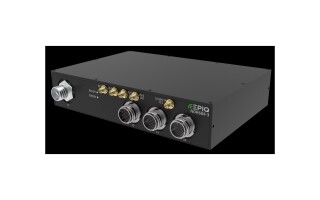
CMFF MCI – a rugged, modular system built around the Army’s C5ISR Modular Open Suite of Standards [CMOSS] – is a scalable, interoperable platform designed to host multiple communications and mission-command capabilities within a compact form factor suitable for mounting on tactical vehicles.
At its core, CMFF integrates critical components such as positioning, navigation, and timing (PNT) devices; tactical communications; and software-defined systems. This integration enables commanders and soldiers to maintain real-time situational awareness, command and control, and effective communications across distributed units.
Combined effort: GDMS and Pacific Defense
GDMS and Pacific Defense won the contract under the U.S. Department of Defense (DoD) MTA Rapid Prototype OTA acquisition vehicle to deliver the CMFF MCI. Initially developed through a rapid prototyping effort, CMFF leverages SOSA aligned principles to ruggedize and enhance the system, meeting rigorous operational standards.
This approach enables rapid integration of diverse components and simplifies future upgrades. The open, modular design has been key to making CMFF MCI fully ready and capable for soldiers to use today. As prime vendors, GDMS and Pacific Defense delivered a comprehensive end-to-end solution, including system installation support, integration, hands-on training, and real-time troubleshooting, thereby ensuring CMFF MCI provides secure mission-tailored communications capabilities that directly support warfighter requirements.
Enabling mission success with SOSA aligned principles
A key enabler of the CMFF’s adaptability and interoperability is its foundation in the SOSA Technical Standard, which is a DoD-driven open architecture standard aimed at promoting modularity, scalability, and vendor interoperability across sensor and communications systems.
CMFF MCI leverages SOSA aligned hardware and software standards to facilitate rapid integration of diverse components and subsystems. This open systems approach reduces vendor lock-in, shortens upgrade cycles, and simplifies logistics and sustainment, all critical factors in maintaining operational readiness in austere and rapidly changing environments.
The SOSA approach’s emphasis on common interfaces and modularity enabled CMFF MCI to leverage Silvus radios for beyond-line-of-sight communications, integrated PNT devices for precise location tracking, high dynamic range+ (HDR+) data links for high-bandwidth connectivity, and Lattice software for flexible network management, all within a single, ruggedized mounted chassis.
Operational impact on Ivy Mass
During Ivy Mass, CMFF MCI proved indispensable in supporting the division’s complex mission sets. Units operated across dispersed terrain, executing attack, defense, and sustainment missions that required continuous, reliable communications under dynamic conditions.
CMFF’s integration on 4ID’s Joint Light Tactical Vehicles (JLTVs) enabled logistical support functions. Commanders from forward support companies (FSCs) leveraged the system to coordinate fuel resupply, maintenance, casualty evacuation, and battlefield circulation in real time. This capability ensured that maneuver units maintained momentum without disruption.
Despite limited training time, soldiers rapidly developed confidence in operating the integrated CMFF communications suite through focused instruction on essential system functions and basic troubleshooting, enabling soldiers to maintain effective communication despite evolving mission requirements. During the exercise, on-site technical support ensured rapid resolution of integration issues, minimizing downtime and allowing soldiers to fully leverage CMFF’s capabilities to sustain battlefield situational awareness.
Future of command-and-control infrastructure
The success of CMFF MCI at Ivy Mass underscores the transformative power of modular open systems architectures like CMOSS and the SOSA approach in modernizing tactical communications. By enabling flexible integration of best-of-breed technologies from multiple vendors, these architectures foster innovation and resilience.
Looking ahead, CMFF’s scalable design means it can evolve along with emerging technologies, supporting future radio waveforms, cyberdefense capabilities, and networked sensors without costly system overhauls. This adaptability ensures that warfighters remain equipped with cutting-edge tools to maintain the battlefield advantage.
Next-generation infrastructure
CMFF MCI, supported by GDMS and Pacific Defense, exemplifies next-generation tactical infrastructure. Its successful deployment at Ivy Mass demonstrates how modular open systems architectures, anchored in SOSA Technical Standard principles, enable agile, interoperable, and reliable communications that directly enhance warfighter effectiveness.
As the Army continues to modernize its command-and-control systems, solutions like the CMFF MCI will play a pivotal role in delivering the operational flexibility and technical superiority that future conflicts demand. Ivy Mass was not just a test of systems; it was a proof point for the future of integrated, open architecture infrastructure solutions empowering soldiers at the point of need.
U.S. Army Program Office · https://cpec2in.army.mil/
The views expressed in this blog are those of the author(s) and do not necessarily reflect the official policy of the Department of the Army, Department of Defense, or the U.S. Government.
The mention of any non-federal entity and/or its products is not to be construed or interpreted, in any manner, as federal endorsement of that non-federal entity or its products.