TECHNOLOGY UPDATE: Marine Corps ARV prototype can control UASs, anticipate component failures
StoryOctober 09, 2025

A new General Dynamics Land Systems (GDLS) vehicle powered by artificial intelligence (AI) and designed in line with the modular open systems approach (MOSA) could serve as the “quarterback” of the Marine Corps’ future mobile reconnaissance battalions, according to a GDLS official involved with the program.
General Dynamics Land Systems has been testing the advanced reconnaissance vehicle (ARV) C4/UAS variant since last year at Michigan Technological University’s Keweenaw Research Center and the Army’s Detroit Arsenal. The vehicle uses AI to anticipate component failures and leverages software that enables the crew to control uncrewed aerial systems (UASs), according to the company. (Figure 1.)
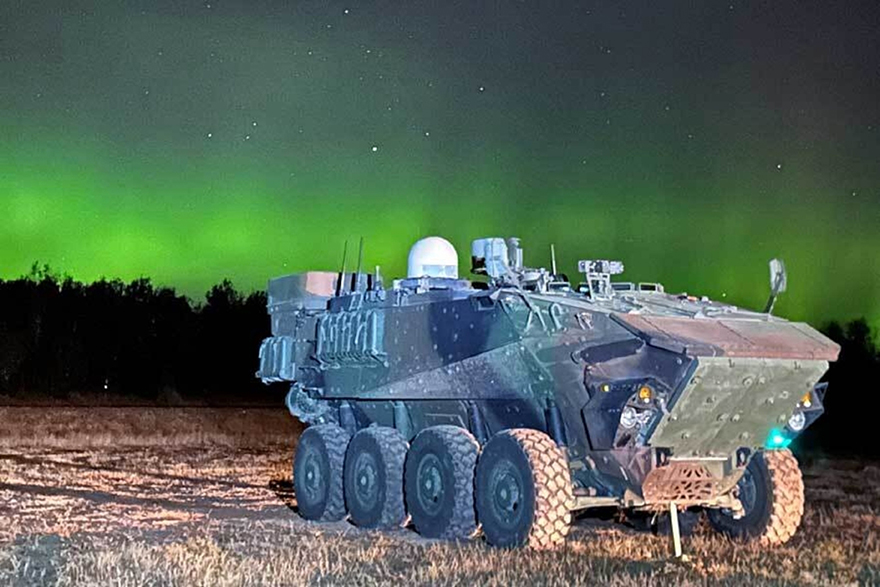
[Figure 1 ǀ A night photo shows the General Dynamics Land Systems C4/UAS Advanced Reconnaissance Vehicle (ARV) prototype and the northern lights during a break in testing in September 2024 in northern Michigan. Photo by General Dynamics Land Systems.]
This ARV variant features the company’s Next Generation Electronic Architecture (NGEA), which is built around MOSA and is intended to help scale the integration of new battlefield technologies. It’s also compatible with the Sensor Open Systems Architecture, or SOSA, Technical Standard, as well as with the C5ISR Modular Open Suite of Standards (CMOSS), says Christopher Dell, ARV program manager for GDLS.
NGEA “strongly supports interoperability and seamless integration with complementary systems and standards,” Dell says.
Dell notes that the design prioritizes modularity at all levels: “Our aim is to make ARV as modular and practical as possible to maintain in austere, field, and combat conditions.”
The university and military-arsenal testing aims to validate advanced logistics capabilities powered by embedded AI. To this end, GDLS uses a predictive maintenance suite known as Vehicle Intelligence Tools & Analytics for Logistics & Sustainment (VITALS), which is intended to increase uptime and mission readiness.
“AI and machine learning are integral to several aspects of our design,” Dell says. “VITALS can accurately predict component failures before they occur, thereby enhancing mission and operational readiness.”
The platform’s communications suite is engineered for integration with uncrewed systems, enabling the ARV to control uncrewed aerial systems (UASs) on the battlefield using onboard software, Dell says.
“A focus area in 2024 and into 2025 involved a maintenance and logistics capability assessment by Marines using the ARV,” Dell says. “To this end, General Dynamics Land Systems has incorporated modern digital maintenance and prognostic monitoring systems in the ARV.”
General Dynamics took feedback from the Marines and modified the design accordingly.
“Testing to this point has included Marines from across the light armored reconnaissance (LAR) and maintenance communities, to mention two important groups of stakeholders,” Dell says. “Their comments often are directly incorporated into iterative design uplifts.”
General Dynamics plans to deliver a second Systems Integration Lab (SIL) in 2025, alongside a new 30-mm ARV variant. The SIL is designed to replicate the full interior environment to provide immersive training and simulate real-world missions with full, representative vehicle functionality, GDLS officials say.