USSOCOM acquisition chief: 'Closed systems are now a liability'
NewsMay 19, 2026

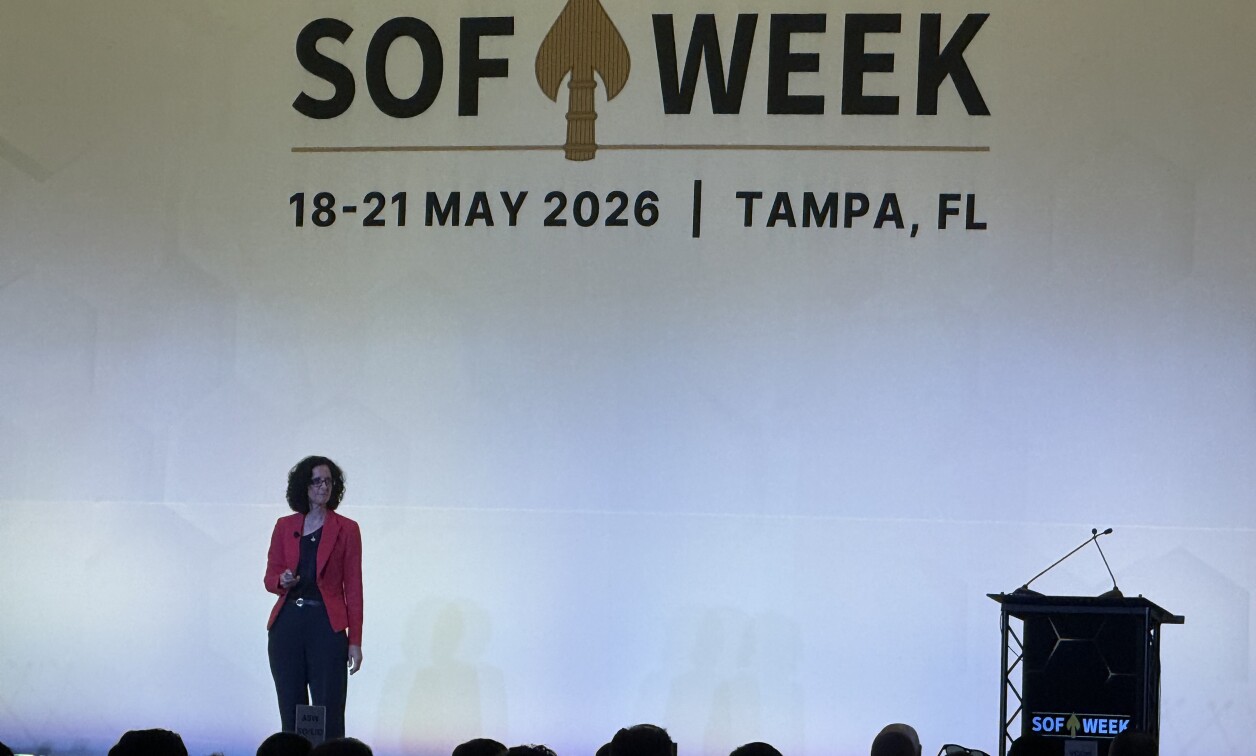
TAMPA, Florida. U.S. Special Operations Command (USSOCOM) will not tolerate closed, proprietary systems -- and is actively working to reopen legacy platforms that have become locked to single vendors, Melissa A. Johnson, acquisition executive at USSOCOM, told industry attendees during her keynote at SOF Week 2026.
"Bring us things that can fit within an open architecture, they're modular, and they're upgradable," Johnson said. "Closed systems are now a liability, and for the legacy systems, we have to open those back up, and some might think that's impossible -- I think it's possible."
She identified three non-negotiable technical requirements that apply across the entire portfolio: open APIs, flexible payloads, and rapid software refreshes.
"Those three things are an absolute must, and that doesn't matter if it's an FPV drone or a gunship -- we have to be able to do those software refreshes, we have to be able to equip the operator with the latest and greatest to ensure they can meet the threats," she said.
Her remars echo those of Deputy Director for Acquisition David Breede during his own keynote the previous morning. Breede warned industry that "having something totally vertically integrated, delivering a black box that we're now beholden to a single vendor to modify -- that's no longer something we really want to go after."
Johnson also told attendees that companies seeking to work with the command must have a robust supply chain in place before engaging.
Her acquisition focus areas slide organized USSOCOM's technology priorities under three headings, each underscored by a command-wide emphasis on AI-enabled, interoperable, and integrated solutions. Under "Provide Operational Reach and Effects," the command is seeking autonomous systems, kinetic and non-kinetic effects, alternative logistics, and increased survivability. Under "Command, Control, and Communications," priorities include resilient communications, alternate positioning, navigation and timing (PNT), and battlespace awareness. A third pillar, "Operator Readiness and Resilience," covers preservation of the force and family, brain health, and blast exposure monitoring.
On the industrial engagement side, Johnson highlighted the scale of USSOCOM's current activity: 37% of contract awards directed to small businesses, 487 active Cooperative Research and Development Agreements (CRADAs), and 10% of contracting obligations going to private capital-backed companies. The Vulcan platform now counts 25,000 commercial users and 15,000 government users, with 1,143 eSOF submissions and 23 open calls currently active. Five technical experimentation events have drawn 2,107 participants and generated 1,149 government assessments of 308 technologies.
A notable expansion for international vendors: the Vulcan ecosystem has been extended to Five Eyes (FVEY) partners -- the United Kingdom, Australia, Canada, and New Zealand -- meaning allied-nation industry can now engage with USSOCOM through the same portal used by U.S. companies. The platform has also integrated AI/ML to support acquisition decisions while protecting sensitive data.