SOF Week 2026: Teledyne FLIR unveils new uncrewed capabilities
StoryMay 19, 2026

Flavia Camargos Pereira
Military Embedded Systems
SOF WEEK 2026--TAMPA. Teledyne FLIR has launched two new autonomous products used for land operations -- the FirstLook 125 throwable personal reconnaissance robot and the improved version of the Rogue 1 uncrewed aerial system (UAS) -- at SOF Week 2026, currently underway in Tampa.
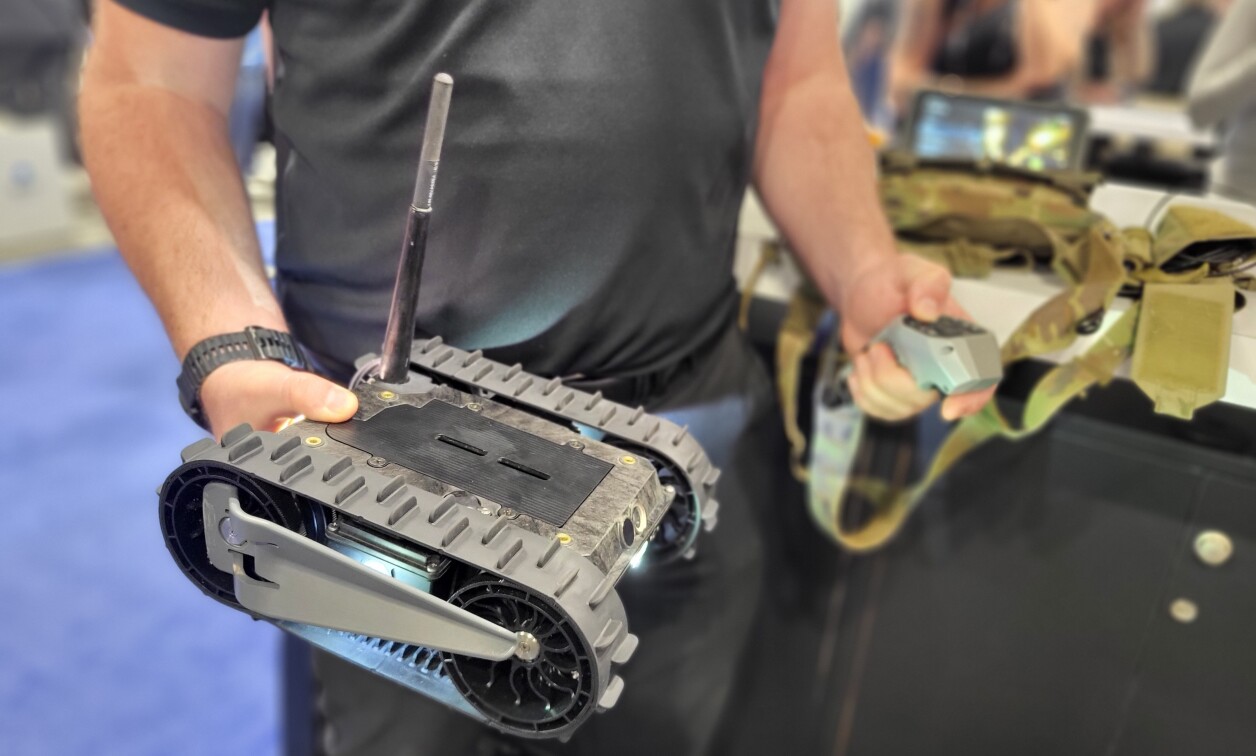
The FirstLook 125 is a lightweight, man-portable, tracked uncrewed ground vehicle (UGV) purpose-built for single-operator carry that is designed to enable rapid deployment and sustained dismounted operations without degrading memory or endurance. The small robot can also be thrown and dropped through windows, doorways, and confined spaces. According to Teledyne FLIR, the small UGV provides real-time visual, thermal, and audio situational awareness across complex terrain. The 5.7-pound (2.6-kg) platform can endure 16-foot (5-meter) drops and therefore can be deployed on stairwells, in rubble, and over uneven ground.
“It actually can sustain being one meter underwater for 30 minutes,” said Nathan Winn, Teledyne FLIR Director of Product Management for Unmanned Systems. “It can go through water [and] through mud, and it is not going to have any negative effects on the system.”
The FirstLook 125 uses rugged, articulated flippers to push through debris, climb obstacles, and maneuver inside confined spaces. It also features an EO/IR camera suite, integrated illumination, and two-way audio with an encrypted radio link for cybersecurity. The solution can be paired with low-latency video and control links for immediate operator decision-making. For ease of use, the FirstLook 125 UGV shares a common controller and operational architecture with the Teledyne FLIR Black Hornet 4 nano drone, which enables a single user to deploy and manage both systems without changing tools or workflows.
When combined, according to the company, the FirstLook 125 and Black Hornet enable users to integrate interior and exterior intelligence/surveillance/reconnaissance (ISR) and maintain continuous situational awareness while transitioning between platforms.
Teledyne FLIR's SOF Week offerings also included the Rogue 1 Block 2 UAS, which was shown after two years of fielding the previous version of this loitering capability with the U.S. Marine Corps (USMC) Organic Precision Fires-Light and the U.S. Special Operations Command Ground Organic Precision Strike Systems programs. Following these field tests, the solution has leveraged user feedback to enhance performance, resilience, and operational capability while maintaining the existing form factor.
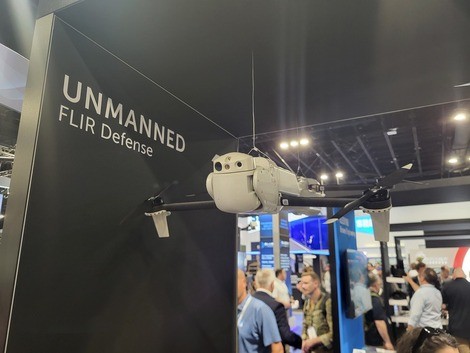
[Rogue 1 Block 2 UAS photo credit: MES staff]
Compared to the Rogue 1 Block 1, say company officials, the new model provides twice the operating range, more than 12 miles (20 km), while its new advanced battery-cell technology adds 20% more flight-time endurance. Additionally, the update features a new anti-armor payload option as well as redesigned propellers for long transit and fast-attack patterns.
Brian Bills, Teledyne FLIR Director of UAS Product Management, noted that the Block two also carraies a different a radio system, “which is more coherent and interoperable with other radio systems being used” by the U.S. military. Additional software and mission-capability enhancements include track landing, improved mapping and visualization, better GPS-denied navigation, and more robust onboard computing.
David Salter, Teledyne FLIR’s Director of U.S. Business Development, noted one of the advantages of the Rogue 1: that it's a user-friendly, straightforward solution: “I can teach anybody to use it. So, if you are an experienced UAS operator, within five minutes you are flying it.”