Middle East conflicts drive surge in demand for autonomous targeting systems
StoryMay 18, 2026

Flavia Camargos Pereira
Military Embedded Systems
The recent and ongoing conflicts across the Middle East have been fueling a sharp rise in the global demand for autonomous targeting solutions. This growing interest has been reflected in acquisition programs worldwide, with armed forces trying to speed up the procurement and deployment of systems.
Bryan Bockmon, chief executive officer of AimLock, a U.S.-based supplier of targeting and engagement systems for defense applications, claims that the situation in the region has “fundamentally changed the pace at which militaries are moving to field autonomous defensive capabilities.”
The wars in the Middle East, as well as the Russia-Ukraine conflict, have highlighted the growing threat posed by low-cost uncrewed aerial vehicles (UAVs), including first-person-view (FPV) attack drones and small unmanned aerial systems (sUASs).
This scenario has forced militaries to rethink traditional air-defense strategies and invest in automated response systems capable of reacting faster than human operators.
“The current events have driven a pretty incredible increase in demand. Systems and products that have been available for years are now being drawn into immediate action,” Bockmon says. “All of the government services, all of the military services, are maturing their programs. So that means experimental programs are accelerating deployments.”
This is the case in the U.S. military, which has been relying on the use of rapid acquisition pathways and prototype Other Transaction Agreements (OTAs) to reduce procurement timelines; an example of this approach is the Pentagon’s Replicator initiative, which was instituted to promulgate ways to cheaply produce large amounts of weapons or systems for the U.S. military.
Meanwhile, the U.S. Army has expedited the purchase of autonomous counter-UAS technologies through the implementation of the Joint Interagency Task Force 401 (JIATF-401), which has rapidly fielded systems such as the Bumblebee V2 and Merops.
Overseas, France, Germany, Italy, Poland, and the U.K. launched the Low-Cost Effectors and Autonomous Platforms (LEAP) effort earlier in 2026 to accelerate joint development and procurement of autonomous defense systems and low-cost drones.
“There have been many direct commercial sales to our partner nation forces,” Bockmon notes. “This is true in Europe, in the Middle East, and in the Indo-Pacific, all at the same time. So, the simultaneity of it is what drives this intense increase.”
The urgency surrounding autonomous targeting systems has also accelerated military testing and assessment cycles. “Combat evaluations are the focus point of the day,” Bockmon says. “That allows active-duty service members to trial the product before committing to large-scale program buys.”
Defense contractors have also been adapting to growing pressure for affordable systems that can be produced at scale. “The low-cost, high-volume solutions are absolutely dominating everything. It is an economic driver, a technology driver, and then a capacity driver,” Bockmon asserts.
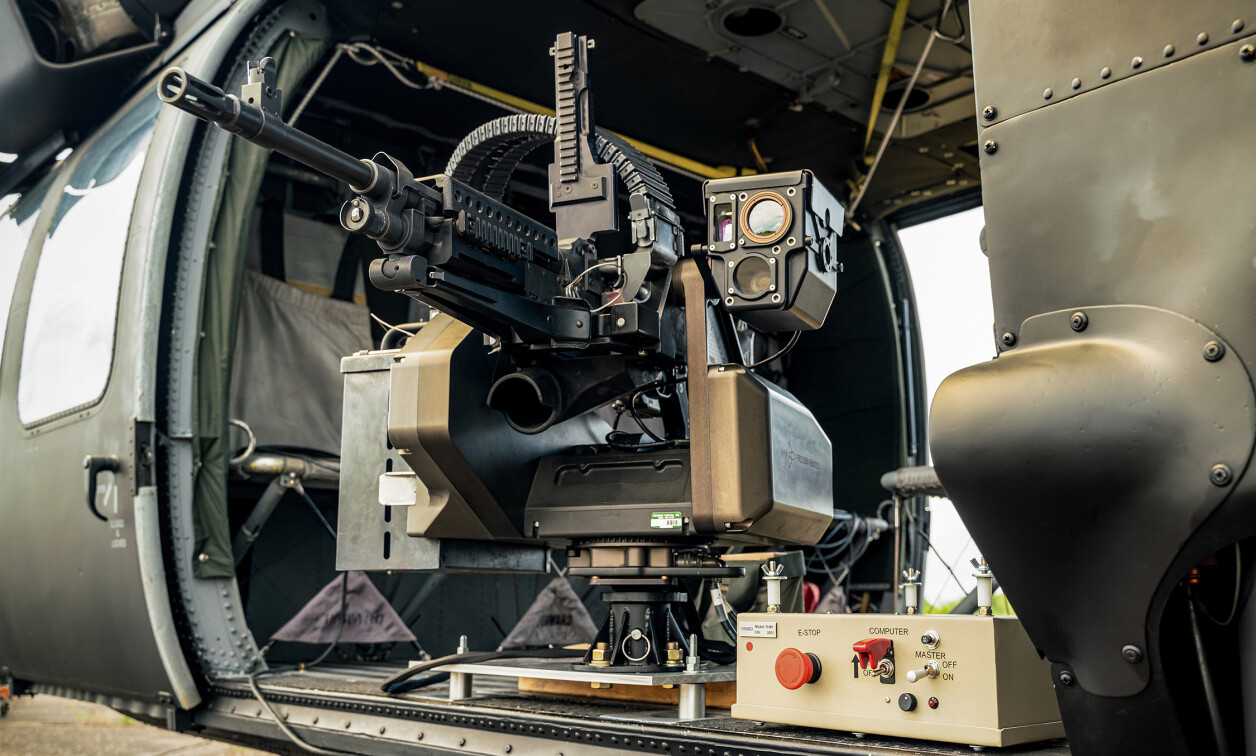
At the SOF Week 2026 exhibition – held May 19-21 in Tampa, Florida – AimLock will display solutions already in operation with armed forces worldwide, such as its Rampart autonomous remote weapon station for medium machine-gun platforms and its Keystone fire-control system.
The company will also showcase its Springer electronic safe and arm device, which was designed to streamline weapons integration, reduce costs, and speed up safety approvals.