
VCNO Kilby acknowledges gap in combat surge readiness, working to reach 80% across fleet
NewsApril 22, 2026

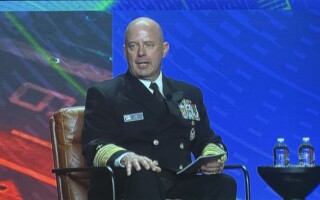
NATIONAL HARBOR, Maryland. The Navy's second in command acknowledged the service has significant work ahead to reach its goal of having 80% of ships, aircraft, and submarines combat surge ready at any given time, using a vivid example from the early days of the Ukraine war to illustrate why the capability matters.
Adm. James Kilby, Vice Chief of Naval Operations, told attendees at the Sea-Air-Space exposition here that while the Navy has made progress toward the 80% combat surge ready threshold, the service is not there yet.
"We've got some heavy lifting to do to reach that goal," Kilby said, noting that he briefs the numbers to the Chief of Naval Operations weekly and has testified on the subject before Congress.
Kilby illustrated the stakes with an account from 2022, when Russia's invasion of Ukraine prompted an urgent request for six destroyers. He said the Navy was able to fill that request, but that identifying which ships were ready -- accounting for training cycles, ammunition, and material condition -- was harder than it should have been.
"If you ask me where the next six are, I would have [had difficulty] because we didn't have a good system to do that," Kilby said.
That experience, he said, drove the Navy's push toward combat surge ready as a formal readiness construct -- a standardized measure of whether a ship, aircraft, or submarine is manned, trained, and equipped to deploy on short notice. The goal of reaching 80% across all warfare communities is tracked continuously and is a central focus of the type commanders responsible for force generation.
Kilby noted that the Navy is currently operating at a high tempo across multiple theaters simultaneously, with 25 submarines underway, sustained presence in the Pacific, and ongoing Central Command commitments -- making the readiness shortfall an active operational concern rather than a theoretical one.