Space computing, radios, microwave electronics showcased at SatShow Week 2026
NewsMarch 30, 2026

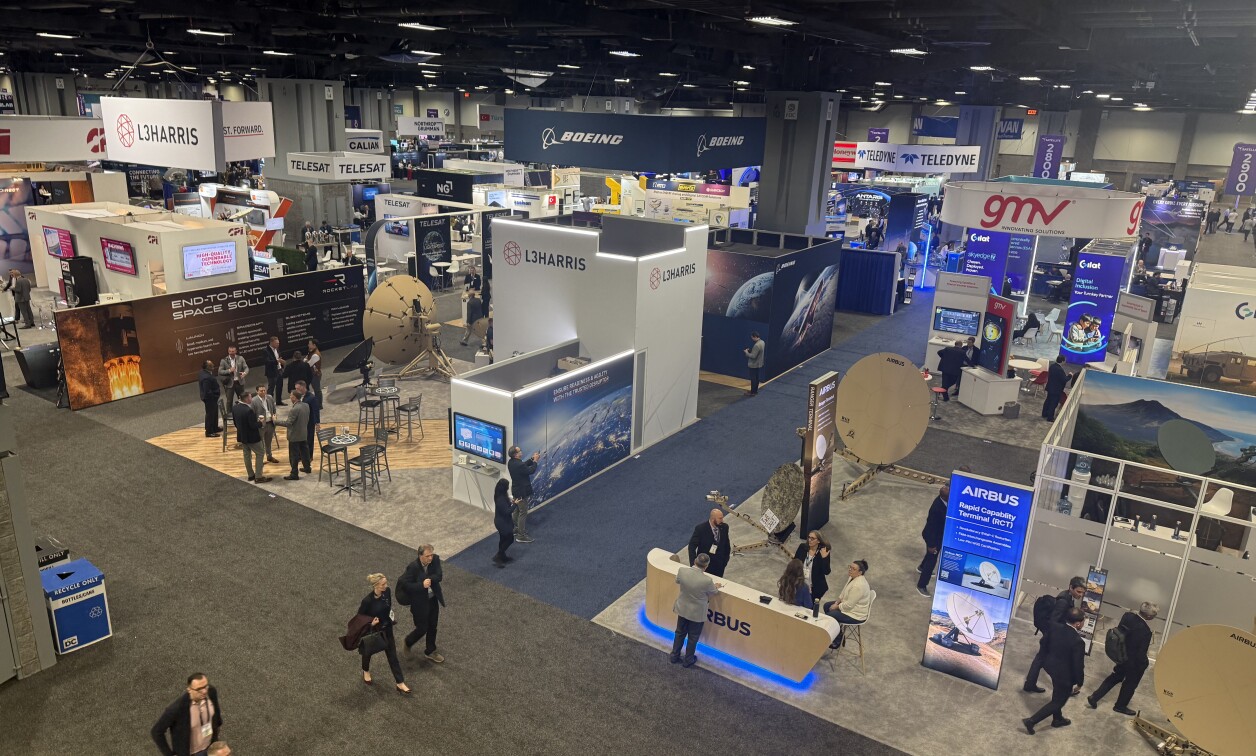
WASHINGTON, D.C. SatShow Week 2026 put a spotlight on the hardware behind modern space operations, with exhibitors showing everything from onboard computers and power modules to anti-jamming antennas, software-defined radios, and virtual ground systems.
One of the biggest themes on the show floor was the push to do more computing in space. Microchip’s aerospace and defense material pointed to that trend through its broader lineup of processors, memory, power-management devices, and radio frequency components for aviation, defense, and spacecraft. That same push showed up in products built around Microchip’s PIC64 High-Performance Spaceflight Computing processor. Moog, for example, showed its Cascade single-board computer, which is designed to handle both payload processing and spacecraft bus functions on one board. IDEAS-TEK also highlighted a compact VNX+ module based on the same processor, aimed at giving smaller systems more computing and data-handling capacity.
Frontgrade Technologies showed how that trend is moving into smaller embedded hardware. The company featured compact computing boards and a power supply module built for size-, weight-, and power-constrained missions. The products were aimed at uses such as payload processing, command-and-control, telemetry, graphics, and artificial intelligence and machine learning workloads in space systems and uncrewed platforms.
Communications hardware was another major focus. L3Harris highlighted high-data-rate transmitters and a modular software-defined radio intended for a wide range of missions, from low Earth orbit to cislunar and deep-space operations. The company’s material emphasized flexible radios that can be reconfigured on orbit and used across multiple frequency bands, reflecting a broader push toward spacecraft that can adapt after launch instead of being locked into one fixed setup.
At a larger network level, SES Space & Defense promoted its O3b mPOWER system as a way to provide fast, low-latency satellite communications with steerable beams and redundant paths. WORK Microwave, meanwhile, focused on the ground side of the equation, showing a virtualized ground-station approach meant to let operators manage key functions through software rather than relying as heavily on dedicated hardware at each site.
Kratos General Microwave’s exhibit showcased another layer of the space stack: the microwave electronics that help make satellite links work in the first place. They displayed synthesizers, up/downconverters, and other components tied to satellite communications, radar, electronic warfare, navigation warfare, and uncrewed systems.
The show floor also reflected growing concern about operating in a contested electromagnetic environment. Calian promoted global navigation satellite system products built to help systems keep working when signals are jammed, spoofed, or disrupted.
Taken together, the exhibits suggested that this year’s show was not just about satellites in orbit. It was also about the electronics, radios, processors, and protection systems that make those satellites more useful -- and harder to disrupt.