SOF Week 2026: U.S. military tests Tycho.AI cannibal drone for contested scenarios
StoryMay 21, 2026

Flavia Camargos Pereira
Military Embedded Systems
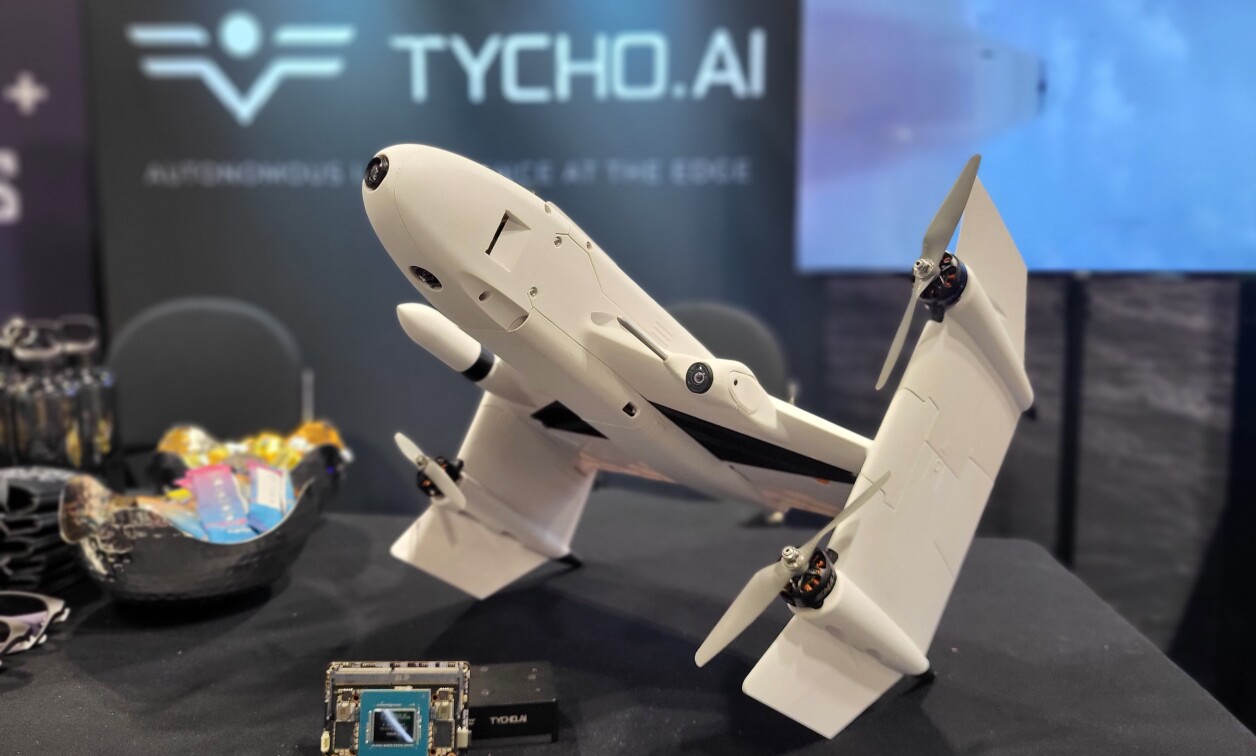
SOF WEEK 2026--TAMPA, Fla. The U.S. military recently conducted trials with "Halley," a new high-speed, low-altitude cannibal drone built by Massachusetts-based autonomous solution maker Tycho.AI.
Halley is a Group 1 vertical take-off and landing (VTOL) uncrewed aerial system (UAS) engineered to operate in degraded, denied and contested environments. The capability was evaluated by the Pentagon and its services and agencies recently at Camp Atterbury, Indiana, during the May 2026 edition of the U.S. Department of Defense (DoD) Technology Readiness Experimentation (T-REX 26-2). It was then showcased at the now-underway SOF Week 2026 exhibition.
Designed for counter-UAS and long-range precision strikes, Halley can be deployed in one-way attack, swarming, ISR [intelligence/surveillance/reconnaissance], search-and-rescue, and scouting missions. The drone can be both operator-controlled in a first-person view (FPV) configuration and/or deployed as a fully autonomous platform for operation in GPS-denied environments. It is capable of providing kinetic and non-kinetic effects with its kinetic version featuaring a 1-kg (2.2-pound) proximity-round warhead.
Phil Pitsky, senior vice president of growth at Tycho.ai, explained that the Halley sensor suite includes an automatic target-recognition system that enables it to visually engage targets. “That determines whether it is a drone, a bird, a target, or not. The human in the loop then confirms that, and the system does its job,” Pitsky said. “Halley’s core is our Voyager low-SWaP [size, weight, and power] technology stack for AI that performs visual inertial odometry, satellite matching, and sensor fusion, allowing drones to fly in GPS-denied environments.”
The Voyager stack also enables the platform to operate independently of global navigation satellite systems (GNSS) at altitudes as low as 25 feet above ground level. This intelligent hardware and software capability also provides AI-enabled obstacle detection, scene understanding, image compression, and high-fidelity map generation.
In the maneuverability arena, Halley is a fixed-wing/folding-wing UAS that launches and lands vertically before transitioning to horizontal flight. It can be equipped with extended-range (XR) winglets for missions exceeding 80 km (approx. 50 miles) or configured for high-speed intercepts and dash maneuvers surpassing 320 km/h (199 mph) over a radius of more than 40 km (approx. 25 miles).
According to Tycho.AI, the drone weighs 5.2 pounds (2.3 kg) and features “a zero-tool assembly and can be transitioned from storage to flight in under 30 seconds,” Pitsky noted. Its modular architecture is 3D-printable and compatible with the DoD's modular MOSA and IOP approaches.
Currently at Technology Readiness Level (TRL) 6, the Halley platform is transitioning from advanced prototype to full-scale production. The company can presently manufacture “several thousand” Halley systems, according to Pitsky, but plans to scale production further.
“The system was originally designed to disrupt the cost curve for countering one-way attack profiles,” he said. “We envision this going to multiple international partners throughout its product life cycle.”