Ground robots leveraging AI to function as a team
StoryJune 17, 2026

EUROSATORY: Paris, France. Robots go first is the motto of the co-founders of Shifters, which designs ground robots that leverage artificial intelligence (AI) to work as a unit.
“Our tagline is ‘robots go first,’” said Ofer Ballin, Co-founder and CEO, Shifters. “Five years from now, I want to see platoons with multiple robots deployed within a platoon, moving in front of the soldiers, doing the front end, clearing the way, and then letting the soldiers come behind them in more safe environment.”
Shifters robots are built to be part of “autonomous robotic teams for dangerous ground missions,” says Assaf Chaprak, Co-founder and President. “We have three main pillars that address this challenge. The first one is robotic boots on the ground, robots that can do the sensing, the engaging.”
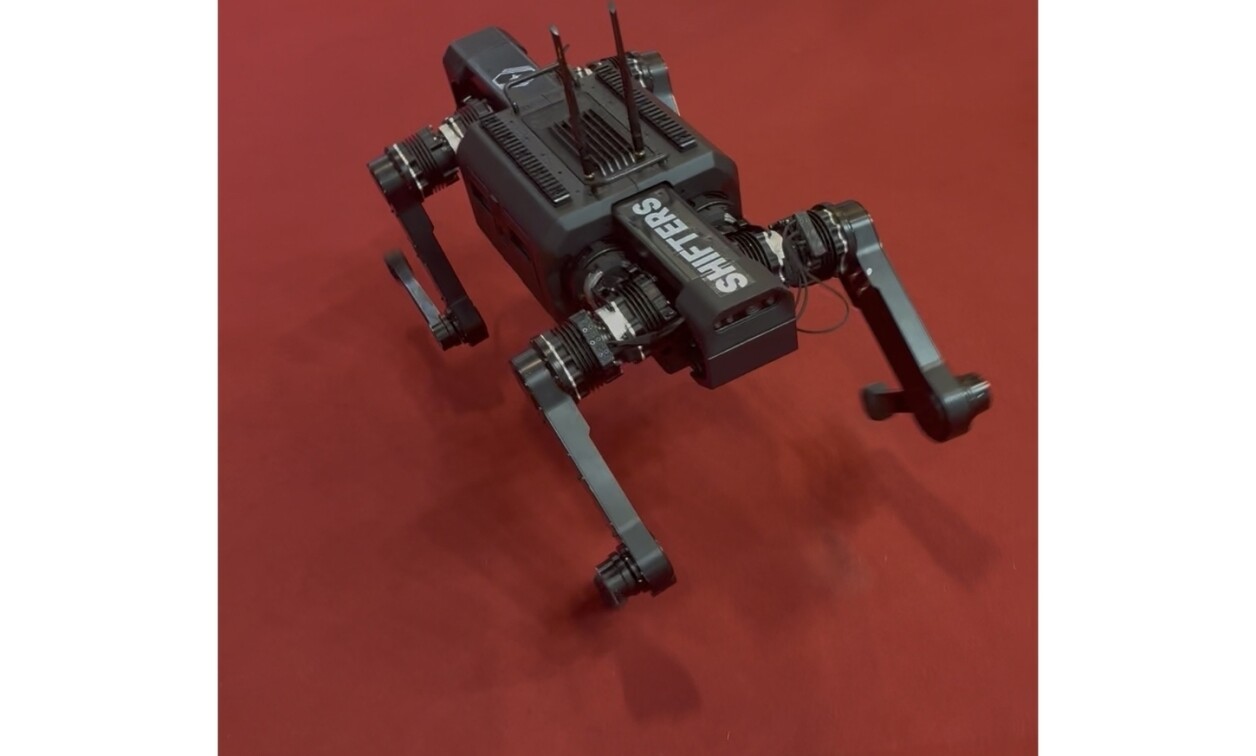
Their platform is a four-legged robot. “You can connect any payload to it, any element to it, and you have two robots – Trust 70 and Trust 50, Chaprak adds. One is larger, just under 50 pounds and the other is just under 40 pounds, and both of them can be carried by a single person and is backpackable," he says.
“The second element of shifters is the RITA, or robotic intent to action,” Chaprak says. “It's what translates a commander's intent into autonomous robotic action in the field. It gives the robot the trust robot. It gives autonomous capabilities the ability to tell it to go somewhere or perform a certain action, and then for the AI control layer, the RITA, to perform that action, and the third pillar is the arena, and that's a multi-agent AI orchestration layer that gets multiple robots acting together synergistically to perform a certain task.”
The third pillar enables the ground robots to deploy as a team or unit, similar to swarming for aerial drones.
It enables “multiple robots to operate as one synergistic unit together," Chaprak says.
The robot is intended for use in rugged, difficult scenarios like climbing rocks. It can lift or carry 15 pounds, 18 pounds, even more within certain parameters, Ballin says. It's also fast, going about 3.5 meters per second (7.83 mph) on flat terrain, he notes.
The robot is designed and developed by Shifters with some commercially sourced components from Western companies, including NVIDIA. Chaprak says they design and produce their own printed circuit boards (PCBs) designs. “There are only Western-made components in this robot, no Chinese modules,” he noted.
"The idea is to get a low-cost solution into the hands of the users in a mass deployment. When we launched Shifters, we knew that the impact we want to make is on preserving human lives, on making on reducing the exposure of humans to danger, getting them out of harm's way. If we only, if we built like a specialized, expensive, exquisite robot that the client could only buy five or 10 or 50 out of.
“We wanted to make a product that the client can buy hundreds or 1000s of and can really make a difference in the field, and so affordability was a major pillar in our decision making on which components to choose, how to design our technology, so it doesn't use the exquisite modules that make the products expensive and more expensive," Chaprak explains.
“What we want to do is to fulfill our mission and see less people having to risk their lives, whenever, wherever in the world there's a conflict," he continues. “What we want to do is to be able to provide the option for something that works, something that is robust, something that can be sent into danger and can perform the necessary task in the best possible way, and we want to do that en mass.”