SOF Week 2026: Obstacles remain regarding broader use of UUVs by U.S. military
StoryMay 20, 2026

Flavia Camargos Pereira
Military Embedded Systems
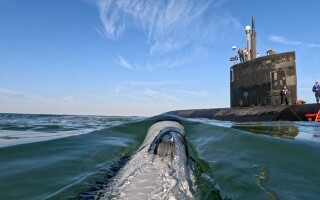
SOF WEEK 2026--TAMPA, Fla. Despite the progress made by the U.S. Department of Defense (DoD) and its branches and agencies over the past several years, the U.S. military still faces a number of challenges as it seeks to further the implementation and operation of uncrewed underwater vehicles (UUVs). Some of these issues are related to the DoD’s acquisition approach and the need to build trust in these uncrewed capabilities.
“What we are trying to do is build different systems that will allow us to be able to fight in a way that we are seeing play out between Ukraine and Russia,” noted Captain James L. Clark, the Commander of Task Force ABLE (Naval Special Warfare) within the U.S. Special Operations Command, during a May 19 SOF Week session.
In this scenario, the bureaucratic government-procurement system, with its multiple levels, has been slowing down the purchase and fielding of new underwater capabilities.
Clark stated that the DoD has been improving its acquisition approach to accelerate purchase timelines: “We readily realized that we screwed up trying to apply the way that we procured and built ships and boats” as regards its procurement of uncrewed solutions.
Currently, the U.S. military operates several different types of UUVs. One of these is the Orca, which is the U.S. Navy’s largest autonomous underwater vehicle. Built by Boeing and HII -- and based on Boeing’s earlier Echo Voyager UUV -- has been designed for long-range reconnaissance, mine laying, seabed warfare, payload delivery, and intelligence-gathering.
The General Dynamics Mission Systems (GDMS) Knifefish, currently used by the U.S. Navy as a mine-hunting autonomous underwater vehicle, operates from littoral combat ships for the purpose of mapping the seabed and detecting buried underwater mines. Another UUV is the submarine-launched Razorback, which can be deployed and recovered through undersurface interfaces; its mission set includes ISR [intelligence/surveillance/reconnaissance], seabed mapping, and mine reconnaissance.
The REMUS family of UUVs -- made by HII on Cape Cod -- is another subsurface system used by the U.S. military. The Navy’s most recent version of this product line is the Lionfish, which performs mine countermeasures, ISR, anti-submarine warfare support, environmental mapping, and electronic warfare (EW) support.
UUVs' various missions also include seabed cable surveillance, harbor security, deception missions, and decoy.
However, to fully implement manned/unmanned operations, the Pentagon may need to rethink, redefine, and more closely detail what missions should UUVs be deployed in.
Clark stated that the “human is going to tell the machine” what and how to perform a task, but this process demands increased trust in and reliability of the solutions.
“We spent thousands of years as fighting societies all across the globe developing trust among warriors and developing trust across the community,” Clark noted. “Now we need to build trust all the way down to the operator level, trust between the operator and the systems that they are going to be employing.”