Software mobility: keeping the U.S. military’s strategic edge
StoryJuly 31, 2025

Michael MacFadden
Sigma Defense

On the modern battlefield, the U.S. Department of Defense (DoD) has long relied on the collection and distribution of data to stay ahead of the enemy. In the most decisive moments, it is critical to make sure information gets in the hands of the right people at the right time to make decisions that could affect the lives of both military personnel and civilians. Programs including CJADC2 – the military’s Combined Joint All Domain Command and Control (CJADC2) warfighting approach – depend on data superiority, which hinges on software mobility.
The U.S. Department of Defense (DoD) has set a course to rapidly advance its data-sharing capabilities since the Pentagon outlined its strategy five years ago. “Adversaries are also racing to amass data superiority, and whichever side can better leverage data will gain military advantage,” said then-Deputy Secretary of Defense David L. Norquist in 2020. “Our ability to fight and win wars requires that we become world leaders in operationalizing and protecting our data resources at speed and scale.”
This goal is seen in programs like the Pentagon’s Combined Joint All Domain Command and Control (CJADC2) approach, which heavily rely on data mobility. While there is no question that being able to move data quickly and efficiently is essential to delivering information superiority, the DoD must also achieve software mobility to continue to dominate.
These two concepts work in tandem to create an environment where it’s nearly impossible for adversaries to deny our warfighters and our allies access essential information that could make or break a mission – even when communications are jammed and those on the battlefield are cut off from command.
This is important because it fortifies the broad, strategic goals of the U.S. military by ensuring access to data not just across the services, but among our partners around the world, whomever they may be and wherever they operate.
Defining software mobility
Put simply, software mobility is the ability to freely move applications around the entire enterprise and run them wherever they need to run based on dynamic mission requirements. While data mobility means moving information toward software – a foundational concept of the “any sensor to any shooter” objective of CJADC2 – software mobility turns that concept inside out, making it the software that moves toward the data or the user.
Software mobility is a force multiplier for military missions, providing adaptability, resilience and efficiency to mitigate the impact of disrupted communications. By enabling real-time data access, streamlined operations and coordinated decision-making, software mobility ensures that forces can sense, make sense, and act even in complete communications failure.
Aligning data and software mobility
Data must move freely and securely across systems, networks and domains to stay ahead in modern warfare. In that sense, true data mobility, which needs persistent communications and robust networking that stretches from the cloud to the tactical edge, is a commendable concept in theory. But on the battlefield, degraded or denied communications are given.
So, if mission-critical functions like command and control (C2) or intelligence, surveillance, and reconnaissance (ISR) depend entirely on the kind of constant connectivity that proper data mobility requires, operational effectiveness will quickly erode, putting both the mission and lives at risk.
That’s why placing agile, software-defined operations directly at or near the tactical edge is a game-changer. It gives operators the power to rapidly deploy and adapt software applications to continue executing mission objectives, even when communications falter or go dark entirely – ensuring the mission moves forward, no matter what.
Understanding battlefield applications
Imagine an operation where an Army squad is forward deployed performing a reconnaissance mission with soldiers carrying full-motion video (FMV) cameras and a small unmanned aerial system (sUAS) flying overhead providing infrared video.
The team carries a comms kit with general purpose compute, IP mesh radios, and satellite communications for data backhaul. The video feeds from all the sensors flow back to a forward command post, where artificial intelligence/machine learning (AI/ML) models detect and identify objects. The detections and video clips are pushed back out to adjacent units through a tactical assault kit (TAK). This is an ideal scenario in which equipment is fully functional and data flows unimpeded.
Next, consider the same scenario, but communications between the forward teams and the command post are jammed. The forward teams lose connectivity to the command post’s TAK server and no longer benefit from the AI/ML system detecting objects. A fragmented picture of the battlespace means that the squad operates blindly, putting the joint force at a disadvantage
That second scenario doesn’t have to happen if software mobility works in tandem with data mobility. When the system detected the loss of communications in the second situation, it would automatically spin up a TAK server and a lightweight version of the object detection model on the forward team’s comms kit. The network would reconfigure so that the sUAS could send its video feed directly to an adjacent team over the mesh network. The soldiers’ ATAK devices (an Android app) would then automatically reconfigure to get the video and alerts from their local device over 5G. (Figure 1.)
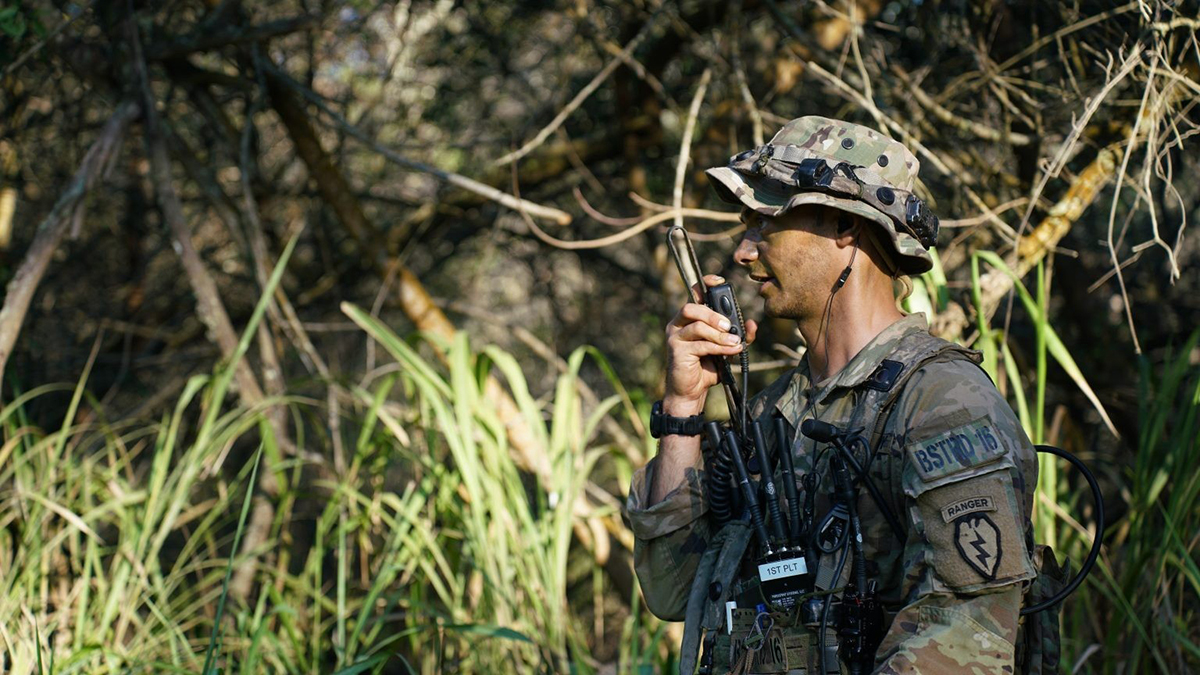
[Figure 1 ǀ A soldier with the 3rd Brigade Combat Team, 25th Infantry Division, uses an ATAK device to maintain mobile connectivity during a Joint Pacific Multinational exercise at Schofield Barracks, Hawaii. Photo by Samuel Brooks, PEO C3T Public Affairs.]
When communications are restored, the locally spun-up TAK server and AI/ML workflows would spin back down to save precious battery power on the tactical comms kit. The system would automatically revert to the previous state, relying on services from the remote command post.
This realistic example clearly shows that when data mobility and software mobility work together, they can provide battlefield teams with the best possible C2 and situational awareness in the face of a communications disruption. This occurs because data flow and placement of applications change dynamically based on the state of the network.
Facing challenges to implementation
The last scenario – whereby software mobility and data mobility work together – is objectively good for the military but is highly complex to implement in practice. The DoD community has traditionally deployed siloed systems in which specific hardware runs specific software that is infrequently updated. When those solutions are updated in the field, the operation often requires highly qualified field-service representatives to fly to forward locations and perform manual updates.
It is still challenging to rapidly field and update relatively static systems, let alone systems that need to dynamically distribute and run software as the mission changes. The DoD must overcome these fundamental problems to bring software mobility within reach and will need to make sure information is available to warfighters and decision-makers where and when they need it. Achieving data mobility and software mobility ensures that joint forces can operate as a cohesive, agile, and adaptable unit in the face of complex and dynamic battlespaces.
Michael MacFadden, Chief Technology Officer of Sigma Defense, has more than 20 years of experience in serving DoD customers. Michael received his bachelor of science degree in software engineering from the Rochester (N.Y.) Institute of Technology and a master of science in computer science from San Diego State University. Readers may reach the author at [email protected].
Sigma Defense • https://sigmadefense.com/