
AI accelerator card under development for in-orbit applications
NewsDecember 12, 2025

ANDOVER, Mass. Modular power-component company Vicor reports that it has been working with U.K.-based space consultancy and design firm Spacechips, which has launched a compact artificial intelligence (AI) accelerator card to enable in-orbit AI applications.
Spacechips has introduced its AI1 transponder, a small on-board processor card containing an ACAP [adaptive compute acceleration platform] AI accelerator. According to information from Vicor, the AI1's reconfigurable receiver and transmitter delivers up to 133 tera operations per second (TOPS) of performance that enables new Earth observation; in-space servicing, assembly and manufacturing (ISAM); signals intelligence (SIGINT); and intelligence, surveillance, and reconnaissance (ISR) plus telecommunications applications to support real-time, autonomous computing while ensuring the reliability and longevity to complete longer missions.
“Many spacecraft operators simply don't have sufficient bandwidth in the RF spectrum to download all of the data they've acquired for real-time processing,” said Dr. Rajan Bedi, CEO of Spacechips. “An alternative solution is accomplishing the processing in-orbit and simply downlink the intelligent insights.”
Given the constrained operating environment of space, AI-enabled computing has an acute need for precision power management. The need is compounded by the expanding number, scope and variety of missions that require different kinds of spacecraft and a growing reliance on some form of solar power to deliver adequate power.
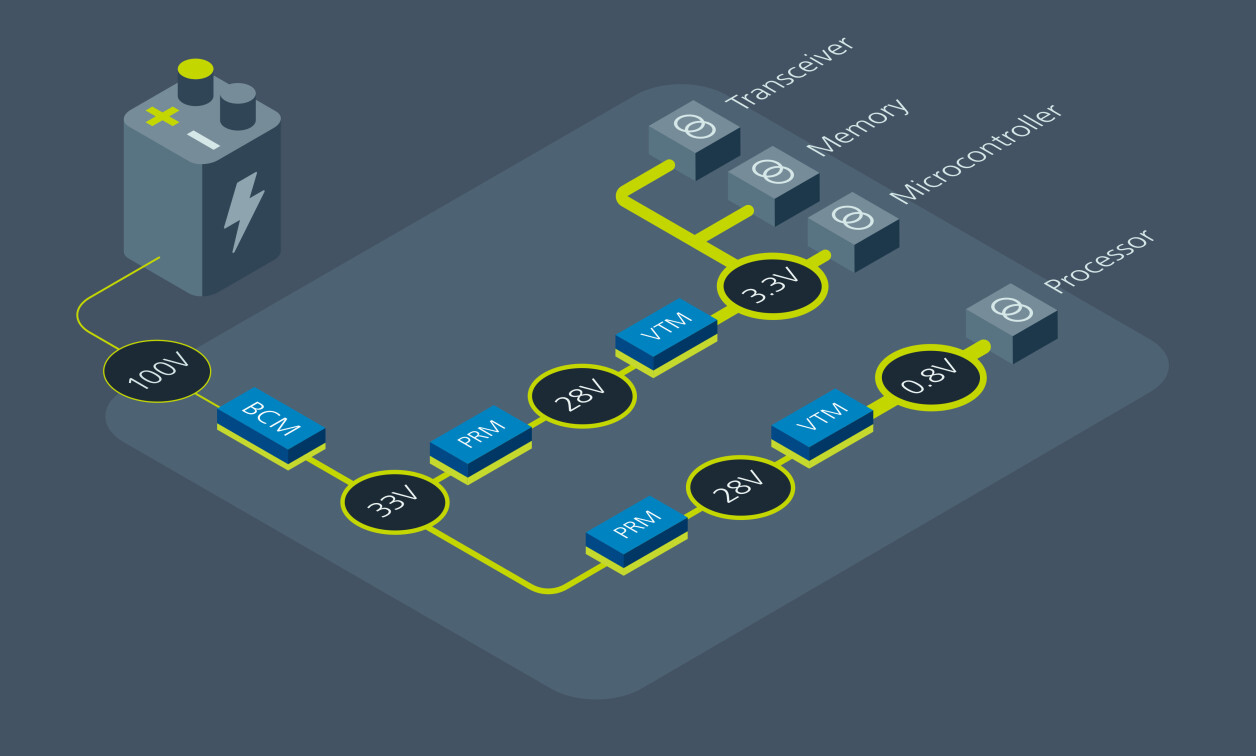
The need for precision power management in the constrained operating environment of space led to the Vicor-Spacechips partnership, under which the AI1 uses the Vicor Factorized Power Architecture (FPA) to place high-density power modules into the Spacechips transponder board. FPA is a power delivery system design that separates the functions of DC-DC conversion into independent modules. The value of the Vicor solution, Bedi states, is that it is very small and power dense, which allows for better efficiency and flexibility by reducing size and weight and yields higher power density, especially in high-performance computing applications.