Combat-vehicle tech, open architectures, military procurement: Q and A with Bill Guyan of Leonardo DRS
StorySeptember 11, 2025


LONDON – DSEI UK 2025. Effective combat-vehicle technology today is being driven by demand for networked sensors and distributed computing, artificial intelligence (AI), and open architecture, Bill Guyan, SVP, Business Development & President, International, Leonardo DRS, told me this morning at DSEI UK 2025. We also talked about how defense procurement for European nations differs from that of the U.S. Department of Defense (DoD). Guyan also shared the biggest technological innovation he’s seen since his time as a U.S. Army tank commander. Edited excerpts follow.
McHALE: We're at DSEI this week. What are some of the things that Leonardo is showcasing?
GUYAN: This week, we're highlighting a couple of different interesting technologies in the area of network computing. We've launched a new line of all-in-one displays, sometimes referred to as smart displays, but a new line of products for us that we think is a good fit for the modernization efforts that are going on, both in the U.S. and internationally.
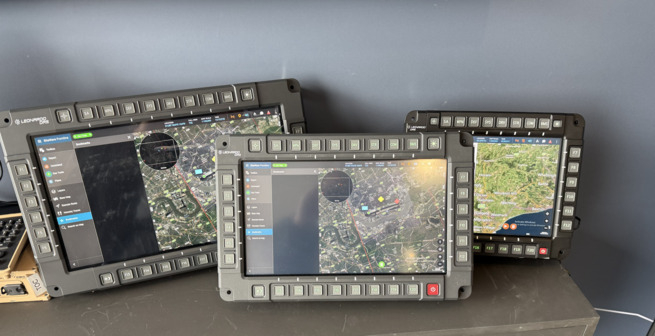
[Leonardo DRS rugged all-in-one-display offerings at DSEI. Staff photo.]
Additionally, we're highlighting the growing range of tactical radars from the Leonardo DRS RADA division, and these are in the sweet spot of a lot of army-modernization efforts right now, driven by a combination of counter-UAS [uncrewed aerial system] demand and also active protection system employment on armored platforms. Notably, the counter-UAS radar is probably the area of greatest interest across the show and across all militaries. I think that the lessons learned from Ukraine really highlight the vulnerability and the threat that's posed by [UASs]. I think all armies woke up and realized that that they don't have enough air defense, they don't have enough capability for detection, so we're seeing a lot of demand domestically and internationally in the counter-UAS area, which I think is probably the fastest area of growth across our portfolio.
McHALE: You mentioned smart displays: Are those for ground vehicles, or are they for other applications as well?
GUYAN: They are primarily targeted at ground tactical vehicles. The environmental performance demands in a ground combat vehicle are probably the most demanding environment there is, and we operate at that high tier of ruggedness, where we try to make sure that we have systems that can endure whatever the soldier has to endure and can be relied upon in harm's way. With increasing emphasis on the network, increased number of sensors on platforms – and coming soon, AI – there’s increasing need for more computing and more user interface through visual medium that requires a display surface to display all the data that's available. So, in some platform architectures, having a single processor that that feeds multiple displays might be the right solution.
However, other customers believe that that having distributed computing architecture provides for more resilient architecture, because if you lose your one computer, not even displays help you, but if all of your displays are smart displays, then you can continue to operate even if you lose one. It also allows you to distribute the computing burden across multiple platforms. This helps you do things like manage heat and get performance out of your network. We see growth in the area of displays, and especially the area of these all-in-one displays.
McHALE: When it comes to requirements, are requirements for displays and rugged computing for ground vehicles similar as they are in the U.S. with the DoD? Or is it different over here in Europe, because you're dealing with different nations?
GUYAN: I think that because the international customers typically buy smaller quantities than the U.S. does, they try hard to avoid demanding some kind of a bespoke solution. Although the GVA architecture was started in the U.K., it's really caught on in NATO countries, and we even see beyond NATO that the term “GVA” is used to designate kind of a standard off-the-shelf, at least user interface, if not electronic interface for displays and computers. So when we look at the international market, products like our all-in-one display are kind of more market-driven requirements, rather than specification-driven product developments. So for us, we have to really understand the requirements so that we can design in a product-development way and cost-effectively build, in some cases, small batches to meet individual customer needs; because we're not anticipating orders of several thousand per year like we might in the U.S., the organization requirements are typically about the same.
One thing we see often is that in the U.S. they'll force you to actually test and demonstrate performance to the climatic ranges that that you say it can meet. Whereas for some international customers, being designed to meet a requirement, rather than qualified to meet a requirement, is good enough sometimes, and so we sometimes see less-capable competitors getting a foot in the door because they say they're designed to meet a requirement and never really tested. Often, those customers become what we call rebound customers because they'll buy from somebody, and they’ll become unhappy, and we’ll explain to them why they're unhappy, and then they'll become our customer in an enduring way.
How armies deal with putting computing architecture into their vehicles varies. There is learning curve there for sure. The U.S., as one of the first movers in this domain, is a very experienced customer. Where international armies can use what the U.S. uses, they feel very confident they're getting something which will survive and has been tested and that's a big selling point for us.
McHALE: MOSA [modular open systems architecture] is a hot topic in the U.S., with initiatives like the Sensor Open Systems Architecture, or SOSA, Technical Standard and CMOSS getting a lot of attention. Are there similar open-architecture initiatives that you see being developed over here, not just in the U.K., but in Europe?
GUYAN: I haven't seen open architecture or MOSA or CMOSS requirements internationally. I have had a great deal of interest and curiosity on the part of our international customers about what's going on – again, because in many cases, the systems and the architectures in use by international armies are not as advanced or complicated as the U.S. All of the benefits that come with MOSA don't necessarily provide value to an international customer that doesn't have electronic sensors, EO/IR sensors, three radios in a computer.
I don't know that it's caught on and that the value proposition is near the same as it is for the U.S. The value proposition for MOSA and CMOSS is tied to three things: The first is complex architecture. The second is high-density systems out there in the field – you make a change, you're changing thousands or tens of thousands of platforms. That's very expensive. And the third thing is a continued commitment to modernization and upgrades. You want to keep the edge with your technical solutions and CMOSS and MOSA promise, the ability to do that more easily, more cost-effectively.
I think also the fact that it is still fairly nascent, in application in the U.S [and that] those international customers that may have a need are still in a wait-and-see approach. I think they’re doing a “let Uncle Sam kick the tires on this” before they before they wade into the pool.
McHALE: How does Leonardo DRS leverage MOSA in the U.S?
GUYAN: We have a number of CMOSS offerings, both from the chassis standpoint and then also the internal card architecture. We have a crypto card that's CMOSS compatible. We are also in the running for participation in the U.S. Army CMOSS program. We have radio cards that are CMOSS compliant, electronic warfare cards which are CMOSS compliant, and we've developed with partners computing cards as well that that work with CMOSS.
[That said] I don't think we're going to see a switch flipped where all things will be CMOSS. It's going to be kind of a hybrid world for a while. I still think that the even for the U.S. customer, the value proposition of MOSA and CMOSS isn't the same for all uses. Some customers will determine that legacy architecture is the best value for their money, the best way to go forward.
With the complex or the new modern systems, you'll see increasing growth of CMOSS and MOSA, but I think we're talking about decades before you look at the fleet of Army vehicles, for example, and everything is CMOSS or everything is MOSA. It's going to take a long, long time for that.
McHALE: I’ve been coming to DSEI for more than 20 years and been in the industry for 30 – walking the floor this week I’m blown away by the advancements in technology over the last two to three decades. Looking back on your own experience in the service from when you first joined the U.S. Army, what are you seeing today? What would you tell that young soldier – what will he see technology-wise 40 years later? What's the most impressive thing?
GUYAN: That's a great question. So, I'm going to date myself. But I was a tank platoon leader in Desert Shield, Desert Storm, and I was in the desert of Saudi Arabia on an M1 Abrams tank. We were far away from any urban environment. We were out in the desert, waiting, trying to deter Saddam from invading Saudi Arabia. And, secondly, to liberate Kuwait. We were given maps, large maps. And these maps were unlike any maps I'd ever seen before, because they were completely tan with almost no relief on them. There were grid squares for the purpose of navigation, but there weren't evident hills. There weren't evident roads and so we would drive, and it was very hard to figure out exactly where you were.
GPS had just been introduced as a technology; our battalion had two GPS and the maneuver units didn't have any GPS. We were issued a LORAN device, which had a long fold-down antenna, and it was used by boaters. So our lead tank had a guy in it that it was holding this LORAN, and it was giving us latitude and longitude that they had to convert to a military grid reference and then look at this tan map and figure out where we were on the tan map, all while we're moving 35 miles an hour across the desert. It wasn't long into the attack when that antenna inevitably busted, and the LORAN signal wasn't so good anymore.
So back to your question. I think it's hard to overemphasize how the availability of position and location has revolutionized all things. Not only does it support maneuver and prevent fratricide, but it also enables precision fires, and this is why I think the assured position, navigation, and timing (APNT), or the threat of having your GPS spoofed or having your GPS denied, is such a big issue for armies – because they've become so dependent upon the ability to know where they are at all times that you almost can't fathom dealing with the idea of not knowing where you are.
Knowing where you are is critical for our business of battle-management systems, because if you don't know where you are, there's no battle management. You can't plot the blue dots. You can't plot the red dots. That's the biggest revolution in military technology in my lifetime: knowing where you are.
[Timing is an essential part] because the GPS also provides time, and that time is used to synchronize the frequency-hopping of radios. You can't have secure communications unless you have time from the GPS. Our ability to have secure communications is also enabled by the GPS system, which not a lot of people know. It really is big revolution and explains why ensuring we have continued access to position, navigation, and timing is so important for the way that the American army fights, because without those technology advantages, you're going back 100 years from a warfare standpoint.