
U.S. & allies 'need to wake up' to electromagnetic threats, White House official says at AOC 2025
NewsDecember 09, 2025

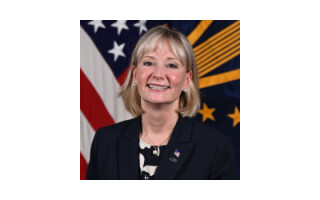
NATIONAL HARBOR, Maryland. Electronic warfare professionals "need to wake up" to growing threats across the electromagnetic spectrum, Laurie Moe Buckhout, Assistant National Cyber Director for Policy at the White House, said during her keynote address to the Association of Old Crows (AOC) 2025 annual conference here.
Buckhout argued that EW and EMS operations remain underemphasized in doctrine, training, and senior leader education, even as adversaries field massed drones, unmanned ground systems, and spectrum-focused capabilities. She cited recent conflicts and cartel activity as examples of how low-cost systems can exploit vulnerabilities in communications, positioning, and data-dependent command-and-control architectures.
“We need to wake up," she said. "You love your country. You love your children. If you love freedom and free nations -- and not everyone here is from America, God bless you, brother. But if you love your free nation, you better wake up."
She warned that forces trained without realistic spectrum denial risk fighting “the wrong war,” leaving command-and-control networks fragile in the face of jamming, cyber-electromagnetic attack, and sensor disruption.
Buckhout said the issue requires leaders who understand spectrum operations as a core warfighting function, not a niche technical specialty.
"We need to get our act together in the spectrum," she said. "Because that's going to enable everything else. So what happens if we don't do that? EW remains a feature limited to a small cadre, rather than a foundational warfighting. Big failure."
Buckhout also stressed the need to close the gap between cyber policy and day-to-day spectrum operations. She argued that network defense, critical infrastructure protection, and tactical EW can no longer be treated as separate problem sets, because adversaries are deliberately blurring those lines with operations that combine hacking, jamming, spoofing, and information operations. If planners do not treat spectrum resilience as a basic design requirement for both military and civilian systems, she warned, adversaries will continue to find seams.
Buckhout also called for more realistic training and experimentation that assumes contested spectrum from the opening minutes of a conflict, not as a scripted inject at the end of an exercise. That means building EW and EMSO into large-scale exercises, wargames, and certification events, she said, and ensuring commanders are graded on how they fight through jamming and degradation rather than how well their networks perform under ideal conditions. Without that shift, she said, forces risk fielding sophisticated capabilities that have never been stressed under the kinds of conditions now visible in real-world conflicts.