Modern warfare, AI, drones outpacing traditional militaries: Eurosatory Panel
StoryJune 16, 2026
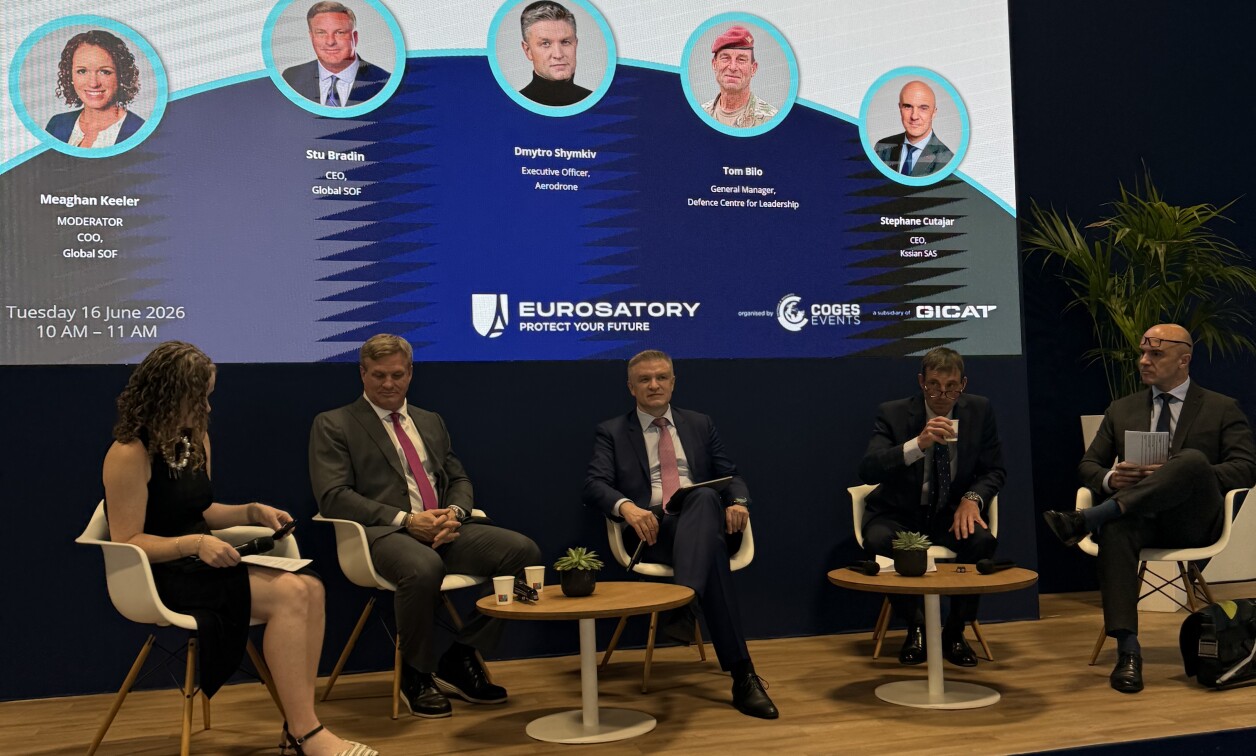
EUROSATORY, Paris, France. Artificial intelligence combined with fast-evolving drones is changing the way warfare is fought, leaving traditional militaries behind, said panelists in “The Asymmetric Edge: How Special Operations and Cutting-Edge Tech are Redefining Modern Warfare,” moderated by Meaghan Keeler, COO of the Global SOF Foundation.
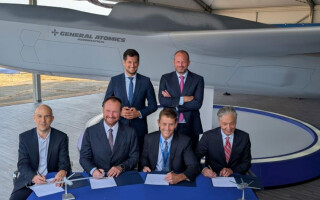
Pictured from left to right: Meaghan Keeler, COO, Global SOF Foundation; Stu Bradin CEO, Global SOF Foundation; Dmytro Shymkiv, Director of Strategic Initiatives & Co-Founder, Aerodrone; Tom Bilo, General Manager, Defence Centre for Leadership; and Stephane Cutajar, CEO Kssian SAS.
This is a pivotal moment in history, as armed forces designed to mass are being successfully countered by forces based on AI and long-range fires, said Stu Bradin (Col., U.S. Army (ret.)), CEO of the Global SOF Foundation. “If you mass in modern warfare you won’t last a day.”
The consumerization of military technology has also made it easier for small groups to get access to combat ready systems like drones, said Dmytro Shymkiv, Director of Strategic Initiatives & Co-Founder, Aerodrone.
These low-cost solutions are replaceing traditional military skillsets as well. “We all used to have snipers,” Shymkiv noted. “How many sniper rifles you see today at the exhibition? How many snipers are currently deployed in the conflict? Gone, that's just a gradually disappearing function. The same thing goes into their armored vehicles, tanks. The best example is the exercises that took place in Estonia and in Sweden, where 14 Ukrainian drone operators shut down two battalions. Everybody was shocked because the quick adaptability using a very inexpensive solution being able to actually wipe out significant portion [of the enemy]."
Industry’s role
To enable this, better industry cooperation behind the scenes with SOF operators will be important so time and energy are not wasted.
“If the industry is not able to adapt to the needs of the situation on the battlefield, the industry is dead,” Shymkiv said. “We have so many cases in Ukraine where very arrogant companies come with very powerful tools, and they failed. Some of them couldn't even fly in a very difficult environment. Then there is another type of company. They bring their team in, and they start working neck to neck with the end user. This is a very important recipe. SOF is equipped for this.”
Educating industry on SOF operator pain points will aid in technology development.
“The major part of the work now in SOF is really to learn what are the new technologies, state-of-the-art drones, AI, etc.,” said Stephane Cutajar, CEO Kssian SAS. “We need to work now to really change the processes in our nations to make sure that companies are innovating.” Having engineers working with SOF operators in the background and innovating and adapting will be important, he added.
Bradin echoed that statement, saying that “we're going to get comfortable with engineers, have them sit side by side with special operators, so they can see what the problems are.”
Don’t forget humans
Panelist Tom Bilo, General Manager, Defence Centre for Leadership, cautioned that with all the proliferation of drones and AI, that the human not be taken out of the loop.
“The distance between the human and the machine is getting smaller and smaller,” he said. “We have to preserve a human advantage because war remains human in Ukraine. Technology has no trust in the population, people have [it]. That's a very important message and the SOF strengths are cultural understanding, building trust, and ethical judgment. No machine replaces that.”
SOF funding and acquisition speed
Responding to a question from the author on whether he is seeing increases in funding for SOF and if acquisition speed can keep pace with technology development, Bradin said:
“We are slowly giving Special Operations more money," he stated, noting that the U.S. SOF budget had been frozen for a few years in favor of tanks and similar platforms, and that the Department of Defense (DoD) is shifting back to SOF.
For procurement to change in the U.S., it comes down to politics, he said. “The issue is politics. In order to get acquisition change, you've got to get parliaments, Congress,” etc., to change [first]. That said, in the U.S. things are changing, Bradin said. He pointed to the Defense Automation Working Group (DAWG). “Their budget is $56.4 billion for next year. So, we are changing. I don't think we're changing fast enough, in my personal opinion, but we are changing.”
To offset slower government procurement, increased investment from the business community in defense companies will be critical. “In the defense industry, 50% of the mergers and acquisitions are private equity,” Bradin said. “That's a good thing. They bring liquidity that can move fast. They're not going to be waiting on government funding, and so I think from that perspective alone that's going to actually accelerate the acquisition cycle.”
Faster cooperation and faster export-control procedures regarding technology in many countries will also be needed to speed up defense technology acquisition, Shymkiv noted.
For more SOF coverage, see our Show Daily SOF Week 2026 coverage here.