Reshaping the contours of warfare: How Western forces are shifting their military strategy
StorySeptember 04, 2025

Chris Morton
IFS North America

Bianca Nobilo
IFS North America

Looking ahead, defense planning and force structure will begin to look different as nations look to adapt to the new contours of conflict, not only to aid nations in active conflict, but also to protect their own countries in the future. Technology is transforming the battlefield – whether the return of attrition warfare, supply-chain shifts, the use of artificial intelligence (AI), drone swarms, or quantum defense – and nations are beginning to alter their defense tactics to compete.
The three-year Russia-Ukraine war has grown into a high-intensity conflict that is reshaping global assumptions on the future of warfare. Throughout the three years, Western military readiness has been put to the test and failed on several counts, whether it’s depleted ammunition stockpiles or a lack of supply-chain resilience.
Attrition warfare, once thought to be outdated, has returned as Russia and Ukraine try to wear each other down. A spotlight has been cast on the battlefield’s ability to combine traditional kinetic operations with low-cost asymmetric technologies.
Supply-chain woes and responses
Ukraine’s artillery consumption outstripped NATO’s production capacity within months, underscoring a fundamental issue: Western defense industries had become structured for peacetime efficiency, not wartime urgency. For decades, spending priorities reflected counterinsurgency operations, not large-scale conventional warfare. Defense manufacturers followed slow, bureaucratic procurement cycles, building to long-term program specifications rather than operational needs. This model is no longer tenable.
A key lesson from the Ukraine conflict is the critical link between battlefield endurance and industrial adaptability. Russia’s defense industrial base was not built for a prolonged war and has struggled to pivot under pressure. In contrast, Ukraine’s ability to draw on external support networks has created a more resilient long-term position – underscoring the strategic value of a flexible, modernized defense industrial base (DIB).
Artificial intelligence (AI)-driven logistics and quantum-enhanced simulations will determine which militaries can sustain modern war. Predictive logistics, already in use in Ukraine, anticipates battlefield demands, ensuring supplies are replenished before critical shortages occur. Indeed, in the context of contested logistics at the strategic level, variables that include a dynamic and quickly changing threat environment require analysis at the speed of AI. At the operational and tactical levels, commanders on the battlefield who have access to sophisticated pattern analysis that studies political, military, social, and the physical environments – among others – can sustain combat operations in theater and force the enemy to consider multiple, complex dilemmas.
AI-driven supply optimization will analyze real-time battlefield conditions to adjust production and distribution dynamically. Nations that fail to integrate AI into logistics, manufacturing, and deployment will be less responsive and fall behind.
AI is reviving the defense industry
Mass production of high-tech weaponry has failed under wartime conditions. The U.S. Replicator Initiative is attempting to reverse this inefficiency by integrating AI-driven automation into defense production. This shift mirrors the years around World War II, when industries like Ford, Hershey, and Singer pivoted to war manufacturing. The difference now is that software-defined warfare demands companies that can handle real-time iteration, rapid scaling, and autonomous system integration.
Ukraine is already deploying AI-driven drone manufacturing, battlefield analytics, and smart munitions at speeds that outstrip traditional defense manufacturers. At the February 2025 Munich Security Conference, Danish Prime Minister Mette Frederiksen warned: “We have a problem, friends, if a country at war can produce faster than the rest of us.” The future of defense production will favor firms that leverage AI to shorten the OODA loop [Observe, Orient, Decide, Act], accelerating design, testing, and manufacturing cycles.
A new low-cost asymmetric angle of warfare
Traditional military platforms are being undermined by low-cost, high-impact technologies: A $500 drone can disable a $10 million tank, and it’s thought that one-third of the Russian navy’s Black Sea fleet has been neutralized by Ukrainian drones. AI-powered swarm warfare – networked, autonomous loitering munitions – has forced militaries to reconsider large, centralized command nodes, which now serve as easy targets. Ukraine’s success in AI-assisted reconnaissance, drone coordination, and battlefield analytics has compelled Russia to adopt similar tactics, both signaling and spurring the rapid evolution of AI in modern conflict.
Speed and scale now outweigh cost and complexity. Monolithic, exorbitant, and slow-moving weapons programs – designed for decades-long procurement cycles – are being reconsidered in an asymmetric context where AI is already embedded in ISR [intelligence, surveillance, and reconnaissance], autonomous drone targeting, and automated force coordination. In previous conflicts, nations without the resources to repel a larger, wealthier adversary were at a significant disadvantage.
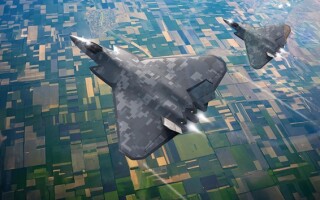
Ukraine has demonstrated that through the precise application of low-cost asymmetric capabilities, its forces can effectively even the stakes against a much larger foe. Many smaller nations will likely take note and look to apply this same acquisition strategy as a hedge against aggression. Larger, wealthier nations cannot ignore this trend – they will not only need to counter this asymmetric threat, but they will also need to develop these capabilities to work alongside major weapon systems. Although power projections and global deterrence still require the employment of “majestic” type weapon systems on a global scale; low-cost AI driven asymmetric capabilities enables a military to present multiple dilemmas to a potential adversary. A great example is CCAs – collaborative combat aircraft – autonomous uncrewed aircraft now under development by the U.S. Air Force and others that are leveraged as a part of traditional fighter development. (Figure 1.)
.jpg)
[Figure 1 The CCA, or collaborative combat aircraft, can be an effective asymmetric capability as part of a force’s traditional fighter-aircraft fleet. Shown is an artist’s concept of the GA-ASI YFQ-42A uncrewed jet fighter, now under development for the U.S. Air Force. Image courtesy General Atomics – Aeronautical Systems, Inc.]
AI and the soldier – who will take charge in battle?
Lethal autonomous weapons (LAWs) are no longer theoretical. AI-assisted targeting is already operational, with Ukraine leveraging AI-enhanced intelligence, surveillance, and reconnaissance (ISR) to predict enemy movements. The debate is no longer about whether AI will be used in battlefield decision-making, but rather how to ensure its use remains ethically constrained, legally accountable, and aligned with international human rights norms.
The key ethical and legal distinction now lies between human-in-the-loop (oversight required), human-on-the-loop (oversight optional), and human-out-of-the-loop (fully autonomous lethal decision-making). A shift toward removing human oversight in lethal engagements risks violating the fundamental principles of proportionality, accountability, and distinction in warfare. If AI decision loops become too fast for meaningful human intervention, militaries risk ceding moral and legal responsibility to algorithms, diminishing the very accountability that underpins the laws of war.
A nation that first entrusts real-time combat decisions to AI would not just redefine military power but could also fundamentally alter the rules of engagement, setting a dangerous precedent for warfare devoid of human ethical judgment. This shift would mark the most profound military transformation since nuclear weapons, but unlike nuclear deterrence, where human deliberation remains central, fully autonomous weapons could remove the last safeguard between war and unchecked machine-driven violence. Any integration of AI in lethal force must be bound by strict legal frameworks and international oversight to prevent an irreversible slide toward algorithmic warfare without moral restraint.
Moreover, AI-driven cyber warfare is already escalating – deepfake disinformation campaigns as a part of a broader psychological operation, automated hacking, and AI-enhanced cyberattacks are becoming standard tools of statecraft.
Reaching the milestone of quantum computing
Technology is not just reshaping the theatre of war, but also its preparation and context: Quantum-enhanced simulations could transform military planning, enabling strategists to model complex, multi-variable conflicts with more granular precision.
Quantum computing’s military potential remains largely theoretical, but its long-term implications are existential. The most immediate concern is encryption: current cryptographic systems will be obsolete the moment quantum decryption achieves practical deployment. NATO, China, and Russia are already racing to develop quantum-resistant security protocols. The winner of this race will have a significant advantage in the future of digital warfare.
On the battlefield and in the bases, AI is reshaping military power
Across several fronts, the race for AI leadership in defense is on. Whether it’s defense organizations struggling to keep up with the unfamiliar contours of AI-driven conflict; both large and small AI organizations entering the defense sector; China and Russia integrating AI across a strategic level; or the U.S., the UK, and other defense forces integrating AI into their military operations, the race is underway. To truly dominate military power in the 21st century, the winner must also be able to scale and operationalize AI across not only defense but logistics, manufacturing, and industrial resilience quicker than its counterparts.
The Russia-Ukraine battlefield has become a live testing ground for the new contours of war, where asymmetric strategies, real-time decision-making systems, and digital warfare are redefining how military force is sustained. But conflict is not won entirely on the battlefield, but by who combines autonomy, agility, and intelligence across their entire defense ecosystem.
It is not only in defense, though, where AI can be decisive. On an economic scale, AI can be utilized to enhance industrial productivity, financial systems, and modern technologies that will all help maintain defense efforts. As AI’s growth continues, it is crucial for defense capabilities and economies to work in tandem, leveraging technology as it becomes the key to strategic longevity and not just a battlefield advantage.
Chris Morton is Global Industry Director for Aerospace & Defense at IFS. A retired attack helicopter pilot with 21 years of military and aviation experience, his career has ranged from leading combat units in operational theatres to shaping strategic planning at the Pentagon. He now advises A&D clients on transformation while driving industry strategy within IFS.
Bianca Nobilo leads AI ethics, government relations, and thought leadership on the Executive Board at IFS. She spent a decade at CNN as an anchor and correspondent, covering major global events and conflicts and previously worked across aerospace and defense briefs in the U.K. Parliament.