Collaborative Combat Aircraft autonomy architecture, air vehicle being developed separately, official says
NewsAugust 27, 2025

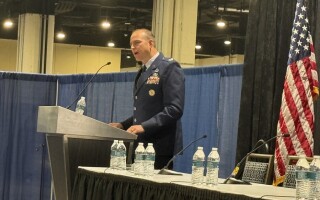
NATIONAL HARBOR, Maryland. The U.S. Air Force is pursuing a new approach for its collaborative combat aircraft (CCA) program by developing mission autonomy software independently from the air vehicle itself, a service official announced during the MOSA Summit here this week.
Col. John Dayton, senior materiel leader for the Air Force Mission Systems Architecture and Systems Engineering Group, explained that the service is applying its autonomy government reference architecture (GRA) to define clear interfaces between aircraft and autonomy software. This allows the Air Force to take the approach of "mission autonomy sold separately," he said, creating a pathway for rapid software iteration while sustaining competition across the program’s lifecycle.
By separating autonomy from the platform, the service hopes to accelerate innovation, prevent vendor lock, and expand the number of companies able to compete for work in the CCA portfolio, Dayton said.
Dayton pointed to early successes, noting that tasks such as swapping out a human-machine interface -- once a four-month effort -- can now be achieved in under five hours using autonomy GRA standards. “It’s proving itself out in the lab,” he said.
The CCA initiative aligns with broader Air Force efforts to embed Modular Open Systems Approach (MOSA) principles into both new and legacy platforms. For example, Dayton highlighted ongoing modernization of the F-22, where open compute environments are being introduced to enable integration with CCA. This capability is expected to support faster software updates and more agile development of operational tactics, he said.
Beyond CCA and the F-22, Dayton said the Air Force is consolidating mission system architectures under a “family of architectures” approach. The goal is to simplify adoption for program offices, reduce duplicative stovepiped efforts, and provide industry with a unified demand signal. These architectures include open mission systems (OMS), universal command and control interface (UCI), the agile mission suite government reference architecture, and the universal armament interface, among others.