Robin Radar launches maritime capability for counter-UAS radar technology
NewsJune 18, 2026

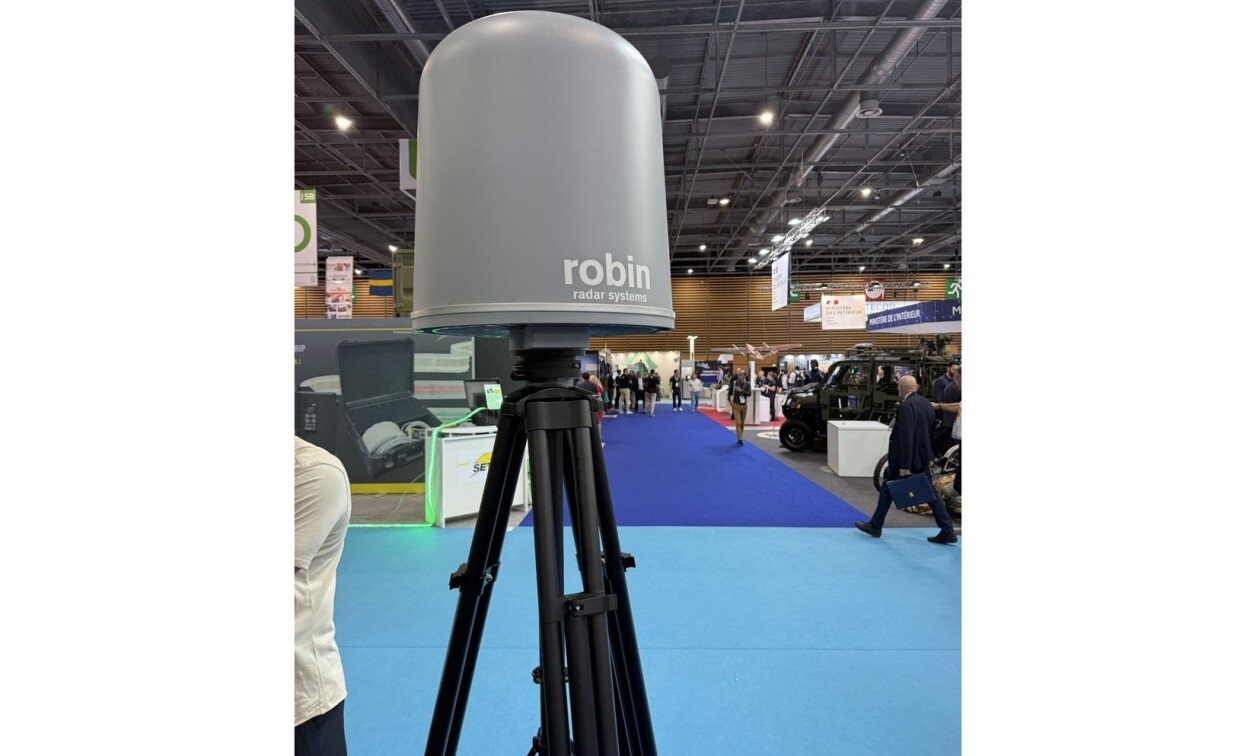
EUROSATORY: Paris, France. Robin Radar Systems introduced IRIS OTM at Sea, an expansion of its IRIS On-The-Move (OTM) capability that brings rapid counter-drone detection to ports, vessels, harbors, and critical maritime infrastructure to counter the growing threat from fixed-wing Shahed drones and low-flying unmanned systems.
“What we are seeing globally is that the drone threat is no longer confined to the battlefield or to land-based infrastructure. Shipping lanes, ports, harbors and offshore assets are now all exposed to low-cost aerial threats that can disrupt trade, damage infrastructure and threaten civilian safety,” says Siete Hamminga, CEO, Robin Radar Systems. “The Strait of Hormuz has once again demonstrated how vulnerable critical maritime corridors can become during periods of instability. IRIS OTM at Sea is being designed to answer that challenge with a rapidly deployable, software-defined capability that can move seamlessly between land and sea.”
Unlike traditional naval radar systems designed primarily to monitor large vessels and aircraft, IRIS is purpose-built for drone detection and classification, capable of tracking drones ranging from hovering targets through to high-speed aerial threats traveling at up to 100 meters per second. The maritime upgrade will be made available across existing IRIS deployments globally without requiring hardware replacement says Vivien Croes, Chief Technical Officer, Robin Radar Systems.
Designed to be mounted on vessels, IRIS OTM at Sea will detect, track, and classify drones while traveling at speeds of as fast as 54 knots. The system is salt- and corrosion-resistant engineering, is built with resonance tolerance, and has an EMC-compliant architecture.
IRIS history
Unlike traditional static radars, IRIS is designed to move with the threat itself, providing persistent situational awareness across dynamic environments. The radar’s software architecture will be updated to filter out heavy sea reflections and environmental clutter to isolate small airborne threats operating close to the waterline.
The IRIS radar is based on design originally developed to detect birds for the Dutch air force in the 1980s, Croes says. “Robin stands for Radar Observation of Bird Intensities.” In 2010, after nearly 30 years of research, it was spun out from a research product and Robin Radar Systems was created as a company.”
The drone detection capability happened while validating the bird radar, Cores says. “To validate our [bird] radars, we are flying drones with a target representing a bird, and we are trying to fly the drone representatively to a bird, and one day, an engineer said, ‘Let's try without the target, do we see the drone?’ The answer was yes, and so Robin was started.
“In 2020 we provided the IRIS radar, for which we own the full technology stack. We have proprietary chips in our radar,” he continues. “The electronics is our own design, the software, the firmware, the AI, everything is ours. This allows us to innovate and upgrade relatively fast, like with the Maritime upgrade, because we don't have to go to a supplier to ask for XYZ every time when to change something.
IRIS leverages Micro Doppler technology, so the antennas, all the hardware allows us to look at the Doppler effect in a very, sensitive way, Croes explains. “We also have developed in house classification of objects using AI. These innovations enable us to do small object detection, identification, and classification very well.”