TSN is changing military network architecture
StoryJuly 31, 2025


Time-sensitive networking (TSN) solves a problem that has plagued military communications for decades: how to guarantee that flight-critical data gets through a network exactly when needed, without interference from less important traffic. For years, defense platforms have relied on separate networks for different functions – one for flight controls, another for mission data, yet another for diagnostics – creating complex, heavy systems that are expensive to upgrade. TSN changes that equation by creating a single, intelligent Ethernet backbone that can turn standard commercial-networking technology into a precision instrument capable of meeting the most demanding military needs.
For decades, defense systems have relied on separate networks for different functions – one for flight controls, another for mission data, yet another for diagnostics. Time-sensitive networking (TSN) offers an alternative “converged network” – a single, intelligent backbone that can handle everything from microsecond-critical flight data to streaming video, all while guaranteeing that the most important information gets through first.
The technology emerged from commercial industries with similar challenges, such as automotive manufacturers merging entertainment systems with brake controls, and industrial automation mixing factory sensors with administrative data. What they all shared was a need for standard Ethernet’s speed and flexibility, but with ironclad timing guarantees.
Now that same technology is making its way into military platforms, promising to simplify complex systems while actually improving their performance.
What is time-sensitive networking?
At its core, TSN is standard Ethernet with a brain for timing. The technology evolved to solve a fundamental problem: how to guarantee that critical data gets through a network exactly when it needs to, without interference from less important traffic.
“TSN in its basic form allows you to basically isolate communication streams such that you can guarantee certain communication parameters,” says Mike Hegarty, marketing manager at Data Device Corporation (DDC – Bohemia, New York). “So it’s kind of like having a dedicated communication pipe through a larger pipe.” (Figure 1.)
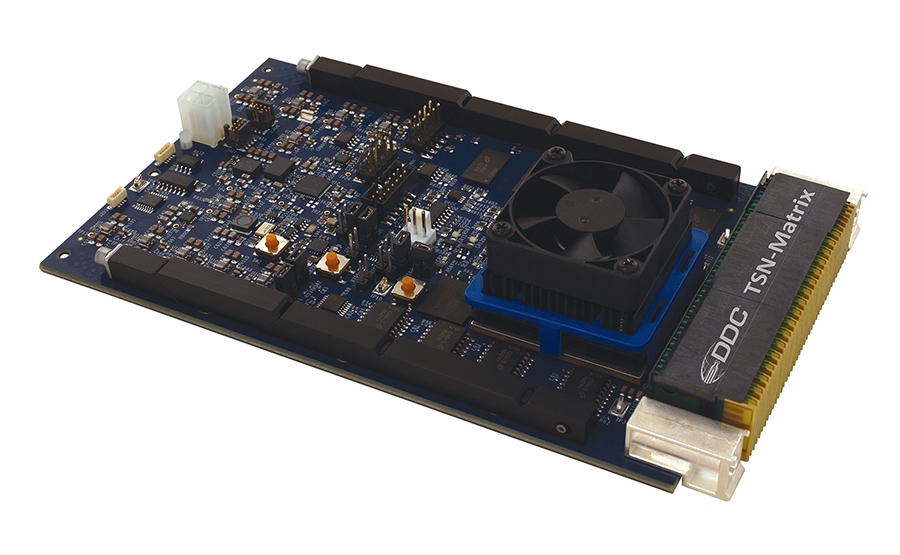
[Figure 1 | DDC’s ET-71202J, a prototype implementation of a VPX-based TSN Switch card.]
Multiple industries faced the same challenge: “They all had common requirements of wanting higher-speed communication using standard Ethernet capabilities to the greatest extent possible, but they needed certain real-time control,” Hegarty explains. “They needed bounded latency and jitter, because if you don’t have that, then the control systems get all wonky because they don’t like indeterminate delays through the network.”
Hegarty likens the concept to a train, whereas other networks are more like congested highways. “A train has a certain schedule,” he says. “You go to the station, you get on the train, and it’s going to bring you to your destination, and there’s no traffic. There’s no stopping it.”
For less critical data, TSN offers something like an HOV [high-occupancy vehicle] lane – reserved bandwidth that provides priority without absolute guarantees. Everything else travels in regular traffic lanes.
According to Michel Chabroux, vice president of product management at Wind River (Alameda, California), TSN can transform defense systems by unifying data and control traffic on a single deterministic Ethernet backbone; reducing system complexity and SWaP-C (size, weight, power, and cost); and enabling real-time performance for applications like fire control, radar timing, and fly-by-wire avionics.
The origins of TSN
The military’s interest in TSN stems from a shift away from using separate networks for different functions. Instead of having one network for vehicle management and another for mission systems, TSN enables a converged approach that handles multiple types of traffic on a single backbone.
Hegarty says his company got involved in TSN development through a standards group led by SAE International, which had been looking at ways to enhance high-speed networks on military platforms. Just last year, the organization put out a paper exploring TSN for military ground vehicles.
The group was tasked by officials at the Wright-Patterson Air Force Base in Ohio to look at ways of coming up with a converged network where “they could take legacy fiber channel Ethernet and something called fiber channel over Ethernet, and kind of blend all these technologies in a way that gives you deterministic communication,” Hegarty says.
The goal was to create “communication that’s appropriate for mission-critical, safety-critical, flight-critical systems, and be able to intermix different traffic classes,” which led to an aerospace-specific profile for TSN called IEEE P802.1DP, he adds.
TSN’s military applications
TSN’s ability to handle multiple types of traffic with different timing requirements makes it particularly well-suited for complex military platforms in which various systems must coexist and communicate reliably.
The aerospace context presents an appropriate example: “Let’s say you’re passing flight information, which may be primary flight display-type data, so it’s the position of the aircraft, altitude, engine speed, and air speed,” Hegarty says. “It doesn’t get transferred all that often because the pilot can only see things so fast. Then you have all kinds of sensor data running, which may be in the form of imagery or radar data or clear data or all kinds of different sensor data. And that’s very high-speed data.”
The fundamental question becomes: Can you set up a framework where you have a common digital backbone connected to high-performance computers that can do all these different functions at once – intermixing safety-critical functions, mission-critical functions, and lower-critical functions while still maintaining the integrity of the system? TSN makes that possible, Hegarty says.
According to Chabroux, TSN is especially suited for avionics networks, sensor fusion systems like radar and electronic warfare (EW), weapons-control systems, autonomous vehicles, and integrated vetronics in ground vehicles.
“TSN can connect radar sensors, mission computers, and displays using a deterministic Ethernet backbone,” Chabroux says. “The 802.1Qbv time-aware shaper ensures radar data arrives in precise time windows, while less-critical traffic (e.g., health/status monitoring) is scheduled in nonconflicting slots – all over one physical cable.” (Figure 2.)

[Figure 2 ǀ TSN is able to use a common digital backbone to enable safety-critical, mission-critical, and lower-importance functions while maintaining the integrity of the system. Stock image.]
Advantages over other protocols
TSN’s primary advantage lies in its ability to provide guaranteed timing over standard Ethernet infrastructure, something that wasn’t possible before without proprietary solutions or separate networks.
“The scheduled transmission piece of it is one of the more powerful concepts that’s in there, because that allows us to have dedicated bandwidth,” Hegarty explains. “It’s not the most efficient for every application, but where you want to have real-time communication, real-time command and control through the network, it’s a way to guarantee that.”
However, there is a trade-off involved.
“You do pay a little bit of an overhead,” Hegarty says. “Like with the analogy of the train, the train is going to leave whether there’s somebody on it or not. You know that bandwidth is dedicated. It’s taken out of the available pool, but it’s there for dedicated functions and dedicated communication.”
Even so, this overhead comes with significant flexibility. “You can tune your network with a combination of time-aware nodes and COTS [commercial off-the-shelf] Ethernet,” Hegarty says.
Chabroux says some of the main TSN advantages he’s seen include eliminating vendor lock-in as TSN is an open standard; no requirement for special cabling, which reduces implementation costs; determinism over standard Ethernet; time synchronization for coordinated actions; scalability from embedded devices to multisystem platforms; and convergence that enables safety-critical and noncritical traffic to share the same network safely.
“Compared to legacy solutions, TSN provides far greater bandwidth, flexibility, and integration potential,” Chabroux says.
Integrating with older interfaces
One of TSN’s most practical advantages is its ability to work alongside existing legacy systems, making it ideal for technology-refresh programs that can’t afford to rip out and replace everything at once.
“That’s one of the beauties of it,” Hegarty says.
TSN addresses a fundamental reality of military platforms: They will always have legacy interfaces that can’t simply be replaced. The solution uses TSN as the main network backbone, then connects older systems through gateways – essentially translation devices that enable different communication protocols to work together.
Chabroux notes that TSN can coexist with legacy gateways or protocol converters such as TSN-to-1553 and TSN-to-ARINC, as well as bridges that preserve legacy input/output (I/O) on the edge while moving core communications to TSN. Also, systems can phase in TSN in new modules while maintaining backwards compatibility.
“This makes TSN a good fit for tech-refresh programs, allowing systems to modernize communications incrementally without full redesign,” Chabroux says.
TSN can even work with standard commercial Ethernet equipment that has no knowledge of TSN protocols. “There is the ability to take standard COTS Ethernet and then bring it into a TSN network, and you can actually shape the traffic when it comes into the network, and be able to get a certain amount of performance out of it and improve the performance of the system without changing that piece of equipment,” Hegarty says.
For example, he notes that if a military operator has a COTS Ethernet-based video camera that provides streaming video through an Ethernet port, and that operator connects it to a TSN network, the operator does not need to know anything about that network – they just need to know what data they need to pull from the camera.
TSN and open standards
TSN’s foundation on open IEEE standards makes it a natural enabler for broader open systems initiatives across the defense industry. The technology’s standards-based approach directly supports the military’s push toward modular, interoperable systems.
“That’s the beauty of TSN – you can get to a point where you’ve got boxes and pieces from different vendors and have a high probability of interoperability,” Hegarty says.
However, TSN isn’t a magic solution that makes everything plug-and-play. Instead, the real value lies in reducing integration costs and complexity.
“What it’s really trying to do is to reduce the cost of switching things and the cost of evolving systems and making upgrades and changes to it,” Hegarty says.
Chabroux says that TSN directly supports initiatives aligned with the modular open systems approach (MOSA), such as the Sensor Open Systems Architecture, or SOSA, Technical Standard and the Future Airborne Capability Environment, or FACE, Technical Standard. It does this by providing standardized, deterministic data transport that aligns with the SOSA modular communication model; backbone support for open module interfaces; real-time support required for the FACE Safety Base and Security Profiles; and vendor-neutral interoperability, which reduces integration risk and cost in multivendor systems.
“In SOSA aligned hardware, TSN is often part of the backplane or data plane fabric, allowing time-sensitive sensor data, mission-critical commands, and general IP [internet protocol] traffic to share a unified transport layer," Wind River's Chabroux says.