New EW signal generator partnership aims to close realism gap in lab testing
NewsDecember 11, 2025

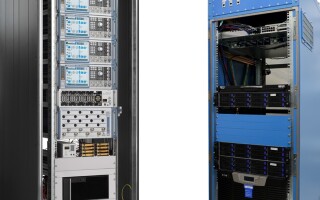
SYRACUSE, New York. A new electronic warfare (EW) signal-generation system from Rohde & Schwarz and SRC is intended to help U.S. Department of Defense labs move away from bespoke threat simulators and toward an open, scalable approach that better matches the complexity of modern spectrum operations, company officials say.
The jointly developed RSGEN system, recently delivered to a major DoD research facility, is built to plug into the military’s Next Generation Electronic Warfare Environment Generator (NEWEG) architecture and its intel-driven Digital Generator (DGEN) component. In practice, that means labs can feed government-owned emitter definitions into commercial off-the-shelf (COTS) hardware rather than commissioning one-off signal generators for each test campaign.
“We’ve been hearing from a lot of our customers over the years that the DoD and its representative laboratories have a challenge when it comes to acquisition of threat simulation systems and simulators,” said Phil Gresock, aerospace and defense business development manager at Rohde & Schwarz. He added that users “definitely value the price and commercial off the shelf readiness” of test-and-measurement gear, provided it can be adapted to EW workflows.
RSGEN pairs SRC’s digital environment-generation software with Rohde & Schwarz’s SMW200A vector signal generators, allowing labs to create dense, overlapping signal environments on each radio-frequency port. The system can combine multiple radar and communications emitters at once without adding racks of extra hardware, which Gresock says is key to “more accurately simulate an environment to really stress that device under test."
Because NEWEG and DGEN are government-managed standards, SRC’s contribution focuses on taking classified or sensitive emitter definitions and formatting them so they can drive the commercial generator while preserving their behavior. “Specific emitters and radars that have a large instantaneous bandwidth… maybe represent emitters that other systems may not be able to use,” said Josh Goodberry, senior business area manager at SRC. By combining those definitions with the ability to stack multiple simultaneous signals per port, he said, RSGEN can create a “dense environment with overlap pulses” for stressing EW receivers, he said.
Scaling was another design goal. At the low end, a single generator can sit on a bench for subsystem testing. At higher tiers, multiple synchronized ports can be calibrated to present a three-dimensional wavefront to a system under test, with timing and phase alignment handled by the RF front end. SRC’s architecture on the digital side is built to scale as well, feeding larger numbers of emitters into that multi-port setup as requirements grow.
Both companies emphasized that RSGEN is intended as a COTS-based alternative to the heavily customized threat simulators that have dominated EW test in the past. “For RF threat simulators, specifically, there was a lot of custom-built hardware,” Goodberry said. By contrast, he noted, RSGEN uses high-volume commercial generators that can be acquired and serviced more quickly, while SRC’s software layer tailors those instruments to EW and radar scenarios.
Gresock pointed to service and lifecycle support as another benefit of leaning on established test equipment. Rohde & Schwarz services “virtually all of our equipment within the United States” and offers different support packages, he said, which is aimed at reducing long-term sustainment costs for labs that may need to evolve their NEWEG-based test environments over many years.