Counter-UAS radars, AI as a combat advantage: A conversation with Bill Guyan of Leonardo DRS
StoryJune 18, 2026

PARIS--EUROSATORY 2026. The threat from uncrewed aerial vehicles (UASs) is getting more complex and difficult to counter, as the conflict in Ukraine continues to show. That threat is also behind the insatiable demand for counter-UAS solutions at Eurosatory (Paris) this week, Bill Guyan, SVP, Business Development & President, International, Leonardo DRS, told me during a chat on Wednesday. We also talked about radar designed for aerial drone detection, European adoption of artificial intelligence (AI), and what must happen for AI to become a combat advantage for the U.S. on the battlefield. Edited excerpts follow.
McHALE: What are you featuring here at Eurosatory and what are the attendees most interested in?
GUYAN: The number-one hot thing for us here is our counter-UAS solutions, where have two lines of offerings. One is our counter-UAS radar line. I think we have the most systems deployed in the world for counter-UAS. We're selling them like hotcakes. We're expanding our production facilities that exist today in both Israel and the U.S., and we're adding manufacturing production facilities in the U.K., India, and Ukraine. There’s a lot of demand, a lot of potential use cases for those.
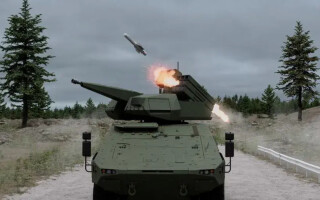
The other line for us is integrated counter-UAS solutions, with both the detection systems and the defeat mechanisms. Not all of those systems come from Leonardo DRS, but we act as the integrator of those systems, everything from high-powered, high-energy lasers from AeroVironment to missiles to 30-millimeter guns. All kinds of payloads, all kinds of radars, all kinds of EO/IR sensors, all kinds of electronic warfare sensors, and other nonkinetic defense mechanisms.
We're putting integrated systems on combat vehicles for the Army, and the Army right now is looking for flexible modular solution for counter-UAS. So, we're looking at taking the mission package – which right now we mount on a turret – and instead of mounting it, making it mountable onto a wheeled vehicle, or putting it onto a sled, so it could be mounted onto a truck and moved around. We've also demonstrated our counter-UAS mission package on an unmanned surface vehicle,
McHALE: I attended a panel on modern warfare challenges earlier this week where the panelists made a point that a lot of the platforms here are designed for deployments in mass, like large army deployments on a battlefield, which is fighting a war from the past. That modern warfare is now about drones, it's about AI, and they feel like Europe – aside from Ukraine – is a little behind in those areas. Do you see a similar trend or something else?
GUYAN: It's a great question. If you consider the start points of many European armies versus say the American Army, it can help to explain the differences in the way that they try to rapidly evolve to meet the new threats.
Some countries are asking how do they start filling large capability gaps. What type of bolt-on-solution they can deploy quickly. Often they're reacting to the threat posed by, for example, [the] Russian army. Depending on their priority, that need might be more tanks, more radios, more ammunition, etc.
At some level, an army will still need tanks, still need artillery. To respond to the new threat you have the layer the response on top of that existing [platform]. The U.S. has the luxury of having a strong start point but still needs to add to it. They're still saying, okay, I need more missiles, I need more production capacity, I need more ammunition.
Each army will react differently to the lessons learned from [say the Ukraine battlefield], but to understand that, why they're doing what they're doing, you got to remember that they're not all starting from the same baseline, and I think that explains a lot of it.
The other thing I would say is that, in addition to the need to build up capability, each nation is challenged with addressing its own gaps in manufacturing production capacity and addressing that in different ways.
We [the U.S.] have a large existing base that's defense-oriented. We're trying to get other [industries] interested. Is Ford interested, is General Motors interested? We’re also taking advantage of the money and the entrepreneurialism of the American economy where there are lots of new entrants to the defense space. That economy helps fuel U.S. military-technology development.
But in Europe, you're not seeing that same creation of new entities. They’re trying to take existing entities and expand them, sometimes that works, sometimes that doesn't work.
McHALE: Let’s talk about AI. I and others I’ve spoken with this week think it’s notable that there many fewer AI software companies [at Eurosatory] than at shows in the U.S. like SOF Week and AUSA. Do you see Europe as being behind in the AI tech race?
GUYAN: Again, I think to some degree, it has to do with your start point. If you want to be able to leverage AI on the battlefield, you have to have spent a lot of money on network infrastructure. Because otherwise you can't hope that your cloud is going to make it to a vehicle. So, right now the number-one priority for the U.S. Army is next-generation command control. [Part of that is] improving the capabilities and resilience of the network, so that it can enable AI, even though they start with arguably the most modern of networks. You have to modernize your network before you can take full advantage of AI on the battlefield.
One of the first demonstrated benefits of AI was the ability to take multiple systems and have them talk to each other or share data through AI. Well, before you can do that, you have to create a unified data architecture so that the data that you're sharing makes sense to another system. Otherwise you put this terrible burden on AI to also be a translator of data.
Initiatives like CJADC2 and the networking solutions being developed for it are preambles to the ability to actually apply AI on the battlefield. We think that that's only part of the job; it may allow command posts to share data with command posts, and exquisite systems, reconnaissance systems, would have to share information with command posts. It probably won't help the guy in a tank, because the guy in a tank is sitting at the end of a network that's likely to be disrupted or interrupted, no matter how good it is.
So now I've got a very capable AI capability, let's say back in my command post, but all that data in the data-rich cloud can't get to me. So how do I leverage AI on the battlefield at the edge; we think you've got to put AI-enabled computing in the vehicles, and you've got to apply first of all physical AI, the integration of the sensor data on the vehicle, so that the commander really benefits from relieved cognitive burden and can make faster decisions. It can sort the data that is on the vehicle so the commander gets recommendations instead of deluge.
By having AI at the edge, not only do you help the commander make faster decisions, but also you lighten the burden on the network. At the same time, you improve the overall common operating picture, because you're going to have data when the network works. You're going to have data that flows both ways. It's going to be filtered.
Less data is going to have to come from the command post, because I can do AI locally. So, I can preload my vehicle with some things you might need to know about. It can take in other data and it can share data locally, so I have a real combat advantage now enabled by AI. Combat advantage at the total force level, at the command-post level, and at the exquisite-system level. But you also have real benefits of AI now in the hands of the commander at the edge of the battlefield, where a faster decision means living.
"By having AI at the edge, not only do you help the commander make faster decisions, but also you lighten the burden on the network." -- Bill Guyan, SVP, Business Development & President, International, Leonardo DRS.
McHALE: What are you offering in terms of AI?
GUYAN: We're already supporting AI in the platform with the U.S. Army's next-generation C2 experiments and we’re loading Lattice and other AI software on our box, supporting AI. We're also demonstrating computers that leverage – thanks to commercial processors that are becoming low-cost and low-power enough – that they can be used in the same type of way that we're using our CPUs now, with a a lighter burden that comes with not having to do a lot of large language models, but having to do do physical AI at the edge.
McHALE: Where do you define the edge?
GUYAN: You know that the motto of DRS is “Own the edge?” By on the edge, we mean three things.
Owning the edge is owning the edge of technology, providing the latest technology. Own the edge means providing comparative advantage, of our forces against someone else. It's giving our forces the edge over someone else. And the third edge is the edge of the battlefield, and the edge of the battlefield is where our forces meet the [enemy] forces. If it's in a tank, that's one kind of edge, if it's in reconnaissance it's in another kind of edge. The force that owns the edge, that has the best understanding of what's happening at that edge, they're going to be able to act more quickly, and that's going to give them the advantage to win.
McHALE: For your counter-UAS radar, is that a radar designed specifically for counter-UAS operations?
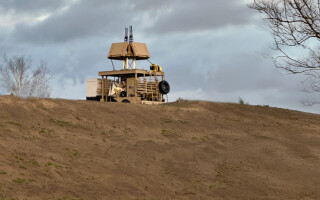
GUYAN: One thing that's unique about RADA radars is that they were specifically designed for the detection of drones, and that allowed us to lower the cost of the radar because it's doesn't have to detect everything that is out there. It also allowed us to make the radar smaller, which also reduces cost.
The most common one that is used is the MHR (pictured at top). We use an AESA [active electronically scanned array] radar and the algorithms are designed to track smaller threats other radars might ignore because they think it's a bird. Whereas we're tuned right to look for the smaller threat and see it, right, not we're looking for the jet, we're looking for the spread.
It is also designed to be mobile and rugged enough to operate on the move. You can put it on your vehicle and track targets while moving.
Our system was originally developed to support the Israeli Defense Force for their local defense. It was tested several times, tested early by real threats and it's become a popular radar used around the world. We have thousands of them in Ukraine.
We’re also seeing the Israeli Defense Force and the Ukrainian Defense Forces network together our radars to create to create a mosaic picture of what's going on, rather than using an exquisite billion-dollar radar to get a picture of the whole front. Instead, there are more than 2,000 of these radars networked together in Ukraine. It’s also harder for the enemy to find the radar because they're looking for it, they want to destroy it. A smaller radar is hard to see. You can mount this on a tree, mount it on a telephone pole, mount it on a building, so it's hard to find.
One other point I'll make in this is that in the Golden Dome program in the U.S., one of the first elements of the architecture that's been decided upon in addition to the ability to detect and defeat hypersonic missiles and other things, there's going to be something called the limited-area defense. This is going to be, if you will, a dome which protects the fixed-side infrastructure. If I'm going to have high-end interceptors right on the base on the ground, or high-end radars that are on the ground, I have to create a dome of coverage, so that I don't get them knocked out by some drone So this idea of creating a bubble of protection, a bubble of coverage, is not just applicable to the battlefield, but applicable to critical infrastructure.